Article by Jasmien for Fashion United: Why everyone is talking about circular economy as the solution?

On ‘Sustainability Clarified’ – a series of Jasmien Wynants for Fashion United.

In this series, we take you into the wonderful world of environmental science. Each article clarifies a key topic related to ‘sustainability’. We zoom out to the bigger picture and then look in more detail at how these complex concepts are linked to the fashion industry.

This time, we talk about… the circular economy.

April 14, 2023, Fashion United

A system under pressure: are there limits to growth?

We don’t really dwell on it, but we live within an economic system every day. A system that changed over the years. Our thinking and actions, here in industrialised countries, are founded on an idea of ‘unlimited economic growth’. Since the end of World War II, consumption has been increasing. We strive for annual economic growth in the form of ever-increasing wealth. But is such perpetual growth realistic?

In nature, nothing grows forever. The means and resources needed to do so are simply not endless. The smallest bacteria to the largest trees have a certain maximum size and at some point reach a ceiling in their growth. That we often assume infinite growth in our economy, with businesses and economies striving for continuous increases in profits and productivity, is contrary to the limitations of our planet. We already see many consequences linked to this today: resource depletion and environmental damage.
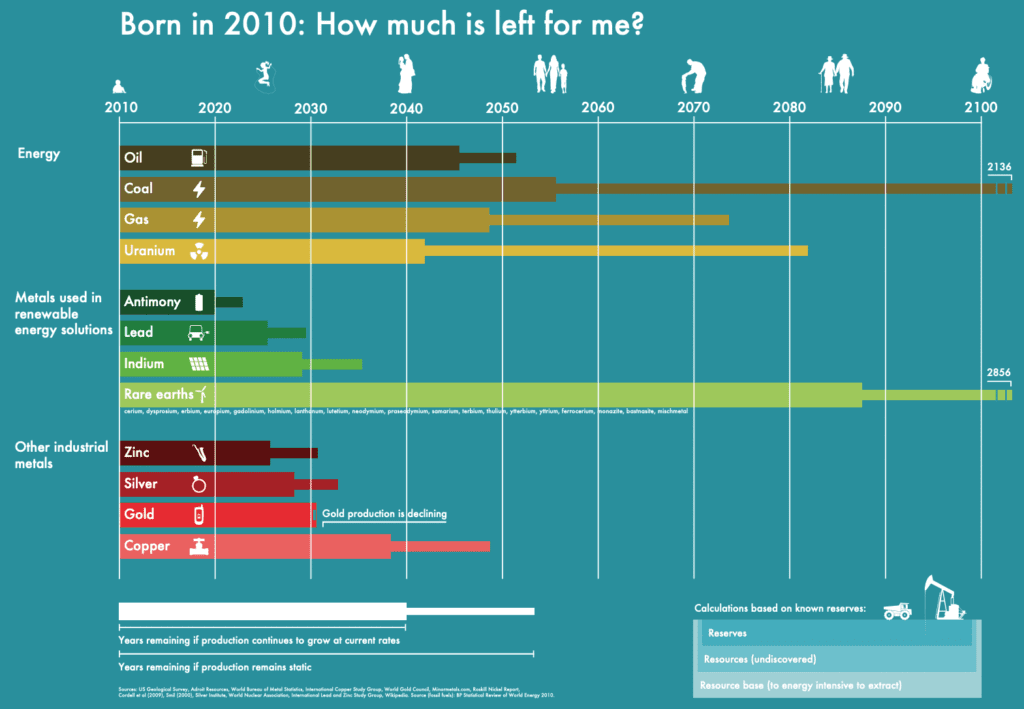
 

Image by Circular Flanders: the depletion of resources

From linear to circular

So a sustainable economy should strive to balance economic growth with preserving the natural systems and resources needed for our prosperity. Hello, circular economy!

We often think of ‘circular economy’ as recycling, but it is much more than that.

The simplest way to explain circular economy is to compare it to the system we know today: the linear economy. That system is based on the ‘take – make – waste’ principle. We take new raw materials (like cotton), we use them to make a garment (like a T-shirt), we sell it to the consumer, who wears it and throws it away again.

The circular economy goes against this and focuses on longevity of products in the first place. The central question here is: how can we use as few new raw materials as possible, use them as efficiently as possible and keep them in the loop for as long as possible? So how do we ensure that we don’t actually create any waste at all?
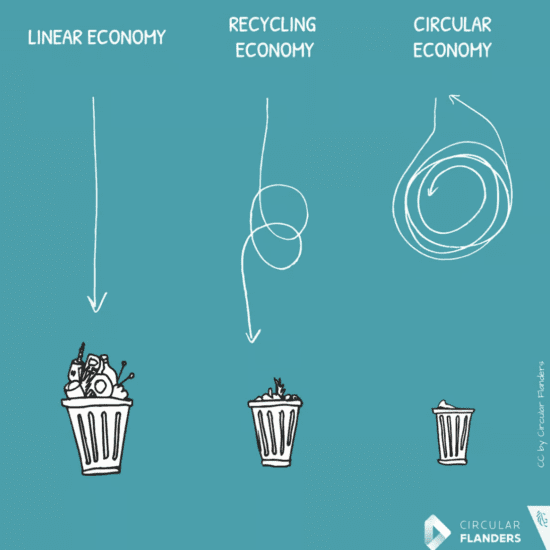
The difference between a linear economy and a circular economy. Illustration via Circular Flanders.

Goodbye ‘planned obsolescence’, welcome ‘right to repair’

Just a step back in history. The concept of ‘planned obsolescence’ emerged in the 1920s. Manufacturers were experimenting with ways to limit the lifespan of products to stimulate demand for new products.

One of the first examples was a cartel of lamp manufacturers formed in 1924 to agree on the production and sale of light bulbs with a limited lifespan. Later, this strategy was also applied to electronics, household appliances, cars, smartphones and also clothing.


Although this concept has been around for many decades, in recent years there has been an increasing focus on its negative impact on the environment and society. There is therefore a growing demand for sustainable and circular products, which are designed to last and are easy to repair and recycle.

The call is also growing stronger from Europe. There, we are looking at a ‘right to repair’ – the right we have as consumers to buy quality items that we can repair. Moreover, the Union’s strategy for sustainable and circular textiles has an important goal in favour of the circular economy: ‘make fast fashion out of fashion’. It even launched an entire RESet the Trend campaign around that.

So what about a circular fashion system?

As you can guess, it’s not easy. To change an entire system requires a transition from one system to another. It is complex but undoubtedly requires efforts from various actors.

Fashion companies must dare to question the current business model. This can be done, for instance, by setting up rental or partial systems or designing quality pieces across seasons (slow fashion). It also looks at closing cycles: can clothes be collected and reused? How can clothes be made to last and be easily recycled in the end? And that without harmful effects on people and the environment?

Consumers also have a role to play because while something may be made to last, shoppers should of course take care of it and not get tired of it too quickly. Between 2000 and 2014, global clothing production doubled (MckKinsey). We are buying more clothes than ever and also throwing them away at an ever-increasing rate. This problem of overproduction and overconsumption is not sustainable. Therefore, it is important to think carefully with every purchase whether you need it and will wear it long enough.

One of the best reminders both for businesses and consumers is the ‘R hierarchy’ that can guide you in making decisions.
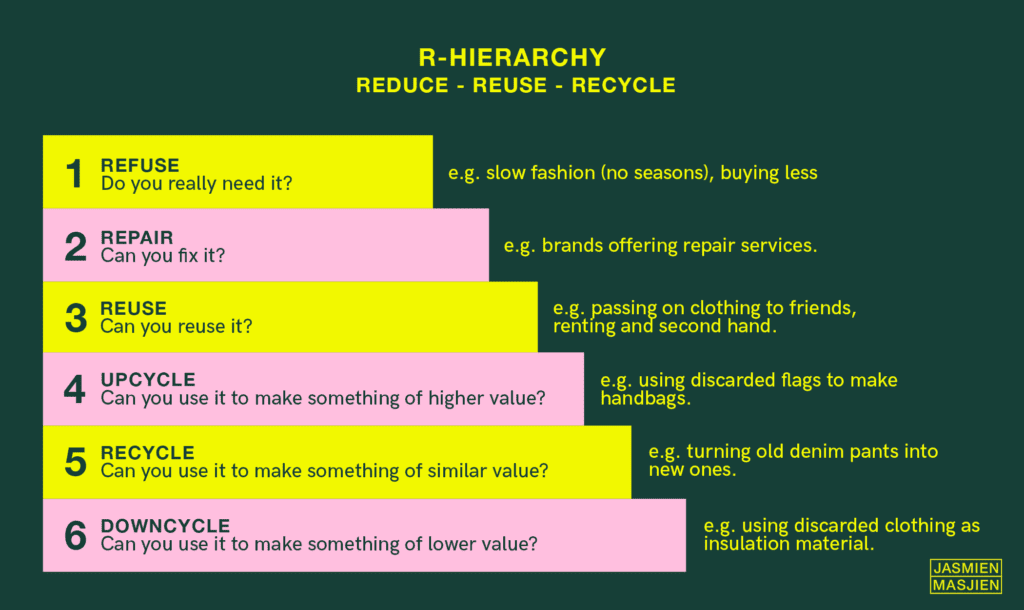
The extended version of the 'R hierarchy' applied to clothing. So the basics: 'reduce - reuse - recycle' can also be interpreted a bit more broadly. Image by MASJIEN.

And then, of course, the key question arises: will all the world’s problems then be solved?

A transition of an entire system does not happen overnight. We sense a system that is faltering and see increasing pressure also from Europe and upcoming legislation gives hope.

However, the fashion industry plays in a global and complex chain with all its challenges. We export and dump a mountain of textiles in Africa and Asia every year. According to EEA. the amount of used textiles we export from the EU tripled in the past 20 years.

In addition, we have also seen great economic success in recent decades with large (ultra) fast fashion players conquering the internet with clothes sold at dumping prices, at unseen speeds and in huge quantities. The most vulnerable in the chain: garment workers in the Far East and low-wage countries still pay the price here.

A circular system is complex but conceivable. It can be part of the solution, as long as we do not lose sight of the international character, the social aspect and the focus on ‘degrowth’ (aiming for a stable level of production and consumption in balance with the planet’s limits).

We asked the scientist… Veerle Vermeyen, PHD candidate circular economy for clothing at KU leuven

“In the previous articles in this series, it has already been mentioned several times that bringing less new clothing to market is one of the most impactful actions to achieve a sustainable fashion system. Doing more with less is central to the circular economy. This can be done by using clothing that is already in circulation as intensively as possible. After all, we then avoid spending unnecessary resources on the production of new clothing and the processing of discarded clothing. So don’t be too easily seduced by messages from companies encouraging more consumption under the slogan of ‘sustainable production’.”

“The benefit of more intensive use may become clearer by thinking about the ‘impact per use’: the more often a garment is worn, the smaller the relative impact of production, transport and waste disposal become in the total life cycle of the garment. For example, the total impact of production and waste disposal of 15 T-shirts worn twice each is much greater than the impact of one T-shirt worn 30 times. More intensive use can be achieved on the one hand by a shift towards ‘slow fashion’, where consumers consciously choose quality and timeless clothing with the intention of wearing it for a long time. On the other hand, there is still room for the necessary variation in outfits through greater use of rental clothing or second-hand channels, where different users together ensure that a garment is actively worn.”

“However, clothing will always age through use and thus be discarded, so new clothing will also always be needed. Here, it is important to think about the use and discard phase already during the design phase, as this will greatly determine the extent to which repair and recycling are possible. For instance, garment-to-garment recycling (a cycle where the materials in discarded garments serve as input for new garments) is currently practically impossible due to the complex mix of materials and chemicals used. Europe wants to address this in the coming years by using new regulations to break down the current barriers to garment-to-garment recycling and thus start closing the cycle.”
Article by Jasmien for Fashion United: What do biodiversity and ecosystems have to do with fashion?

On ‘Sustainability Clarified’ – a series of Jasmien Wynants for Fashion United.

In this series, we take you into the wonderful world of environmental science. Each article clarifies a key topic related to ‘sustainability’. We zoom out to the bigger picture and then look in more detail at how these complex concepts are linked to the fashion industry.

This time, we talk about… biodiversity and ecosystems.

November 15, 2022, Fashion United

Ecosystems and ecosystem management

An ecosystem is a system that comprises all organisms within a given area, their interaction with each other and their interaction with the environment. Plants, animals and micro-organisms influence each other and together form a living community. It involves both ‘nature’ (forests, rivers, grasslands) and ‘culture’ (fields, plantations).

The latter systems are ‘managed’ by humans to optimise yields (food, fodder, timber). However, nature can also be managed, often with the overall aim of preserving (or restoring) biodiversity.

Is it about ‘nature management’ then?

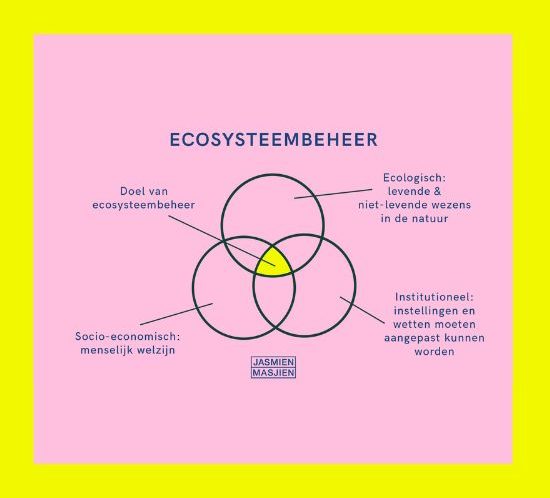
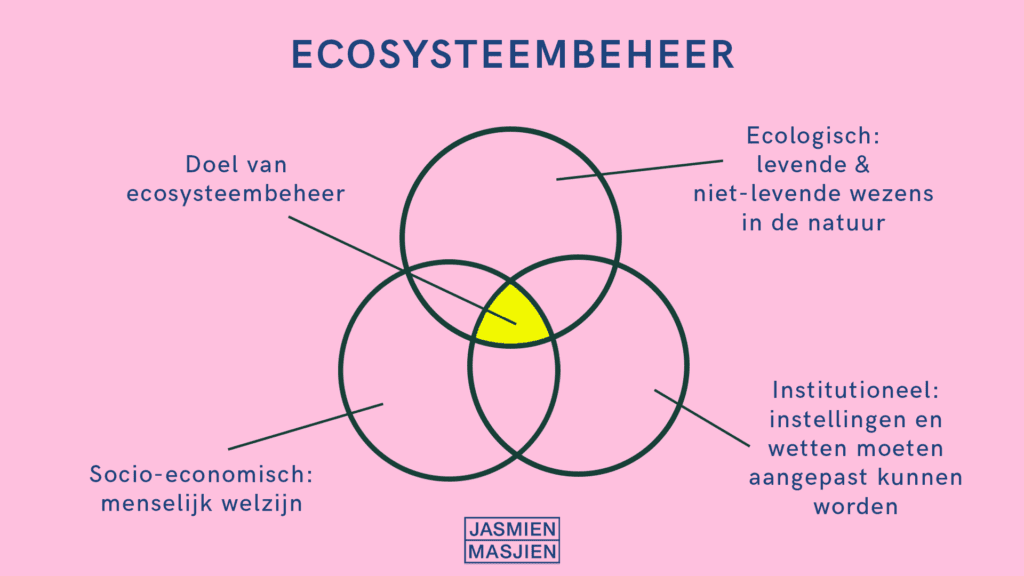
There is an important difference between ‘nature management’ and ‘ecosystem management’. The latter explicitly looks at human benefit. After all, ecosystems perform a number of functions that are valuable, such as pollinating crops, absorbing CO2 from the atmosphere, etc. These are called ecosystem services. 

Ecosystem management puts our human needs at the centre of biodiversity management and looks for 'win-win' solution

Globally, we are seeing a decline in these ‘ecosystem services’. This has not only ecological consequences, but also an economic impact. To give an example: many tropical coastal areas (think of exotic destinations like Fiji, Aruba or Indonesia) are home to mangroves. These are coastal forests whose large, thick roots can often be seen protruding above the water. Mangroves are very important for biodiversity and carbon sequestration, but are highly threatened worldwide. If mangroves disappear around coastal areas, not only is it detrimental to biodiversity, but also the protection of that coast (and the people who live there) is threatened, as well as the income from tourism linked to these sights. There is a correlation between ecology, economy and human carrying capacity that we often give too little thought to. 

Biodiversity loss 

Biodiversity is the variety of life, in all forms on Earth. It is not just about the number of species, but also their genetic variation and the interactions these species have within complex ecosystems.

Earth’s biodiversity is declining. This is partly due to an ever-increasing ‘extinction rate’. Normally about 1 to 5 species die out per year, but scientists estimate that this rate is already 100 to 10,000 times higher. Beyond that, ‘biodiversity loss’ is more than mere species extinction, but also involves the decline of populations. This is largely due to human development. The huge growth in population has far-reaching and complex consequences (as you can also read in the piece on global warming), including impacts on freshwater, pressure on agriculture, flood risk, more diseases, more deaths from heat and climate refugees.

And why should we care? 

The decline in biodiversity has a bigger impact than we sometimes think. A species lives in an ecosystem and affects it. Protecting tigers goes – to put it bluntly – far beyond ‘saving those beautiful critters’. Predators keep ‘prey animal’ populations down. If the predators disappear, herbivores are given free rein, and that too can have major consequences for an entire ecosystem.

Another example is deforestation. This not only leads to the disappearance of the panda and orang-utan, but has major consequences for nature and humans. The more trees we cut down, the more CO2 is released (especially from the forest floor) and the faster the earth warms up. The more natural areas are affected, the greater the risk of (new) viruses jumping from wild animals to humans. By reducing forests, humans and animals live closer together. In addition, we also come into contact with potential pathogens during logging, which would normally remain in a contained ecosystem.

The European Commission indicates that more than a football field of forest disappeared every second in 2017. Deforestation is most concentrated in tropical rainforests. These disappear at a rate of 13 million hectares a year. Or also: about the size of Greece.

Biodiversity loss thus plays a crucial role in all kinds of processes, including climate change, and is linked to many changes. Humans are the main cause of the rapid decline in biodiversity, but can therefore take action to change this.

Man inside or above an ecosystem?

When we talk about climate change, we are quick to say ‘we are doing it for the planet and nature’ or ‘we want to save the earth’. Understandable, as scientists estimate that 99.9 per cent of all species are already extinct (on a timescale of 3.5 billion years). However, what we often forget is that we humans are also just one species. Earth has existed for about 4.5 billion years. Humanity about 200,000.

Man’s impact on the environment and nature has increased exponentially over the past few decades. So curbing its impact, we are certainly not only doing it ‘for the planet’, but also (and maybe even mainly) for ourselves and those who come after us.

And can we talk about fashion now?

Unfortunately, the fashion industry also contributes to biodiversity loss.

Cotton is used in about 25 per cent of our clothes. We consume clothes like hotcakes. To maintain this rate, a huge area of land is needed to grow cotton. On top of that, cotton grows best in warm countries like China, India, the US and Brazil. Since cotton is a very thirsty crop, it often strains rivers and groundwater in those regions, leading to soil depletion and water shortages. One of the most famous examples is the parched Aral Sea on the border of Uzbekistan and Kazakhstan. The lake used to be one and a half times the size of the Netherlands. Today, all that remains is one big sandpit.

And to add to that, growing cotton requires a lot of chemicals that not only damage the soil, but also cause a lot of insects, birds, trees – entire ecosystems – to disappear or wither away.

There is one material that is used even more than cotton: polyester (62 per cent of our clothes contain polyester or some other similar oil-based material). When polyester clothes are washed, tiny micro-plastics are released every time. Those tiny particles flow with the water from our washing machine, through the sewage system and along rivers and lakes to the sea. Not surprisingly, this has a major effect on marine ecosystems.

Also during the production process (mostly during dyeing, bleaching, coating, post-treatment), very harmful substances often end up in the water streams around the production facilities. In the factories where our clothes are produced, wastewater is far from always properly treated before it is discharged. This will be discussed in more detail during the next contribution.

Perhaps a positive note?

The fashion industry is looking for ways to do better. Some of the initiatives that can have a positive impact on biodiversity include:

  • Using regenerative farming techniques for natural materials.
  • Sustainable forest management for fabrics such as viscose, bamboo and other fibres that use trees, grasses or plants (you may also recognise the most well-known label from paper bags: FSC)
  • The search for systems to filter out microplastics when washing our clothes
  • Initiatives that encourage us to buy less and wear our clothes longer so that there is less need for new raw materials.


.

We asked the scientist… Hans De Boeck, Global Change Ecologist at the University of Antwerp 

“Biodiversity loss is closely linked to other ‘global changes’. Each of these global changes has negative impacts on biodiversity, either directly (think deforestation and overexploitation) or indirectly (through climate change, pollution, the encroachment of invasive species, etc.). Thus, when we address these global changes, we also ensure that biodiversity loss is reduced. So many of the measures the fashion industry can take to reduce its climate footprint, for instance through more sustainable use of materials, are also important for reducing pressure on diversity. In addition, work can be done to minimise harmful techniques and processes throughout the chain, from raw material (e.g. pesticides, water use) to end product (e.g. during dyeing and bleaching, transport) and afterwards (e.g. washing, recycling).

The biggest challenge, however, is ever-increasing clothing consumption. If the benefits of better production techniques, recycling, etc. are outweighed by simply producing more and more clothing, then obviously there is no progress. The danger here too (just as was noted in the article on climate change) is ‘greenwashing’ by (parts of) the fashion industry: taking marginal green steps to ease the conscience of consumers and thus sell more and more. The most ‘green’ clothing is still the one that should not be produced.”

Future Fabrics, what?​

Sustainable Fashion explained for teenagers for VRT NWS (Belgian news)

VRT NWS asked Jasmien to work together on a short video explaining some of the basic concepts of sustainable fashion to share with schools in Belgium.

Sustainable fashion explained for teenagers?

VRT NWS asked Jasmien to work together on a short video explaining some of the basic concepts of sustainable fashion to share with schools in Belgium.

It wasn’t an easy job but the crew was amazing and we’re quite happy with the result. What do you think?

Interview Fashion United: More legislation is required in order to change the industry

Interview with Jasmien in Fashion United about European policy and her Master’s thesis on the subject, written by Natasja Admiraal

Isn’t it a crying shame that an industry responsible for producing so many beautiful products, simultaneously has such an incredible impact on both people and the planet? Anyone who decides to take a somewhat more detailed look into the ‘ugly’ side of the fashion industry will not be able to help but lose sleep over this, according to Jasmien Wynants. She has spent the last seven years conducting research into sustainable entrepreneurship and the circular economy at Flanders DC (the umbrella organisation for creative individuals in Flanders), with one single goal in mind: to improve the fashion industry.

It was starting to become abundantly clear to her that changes in both the industry and consumer choices simply wouldn’t be enough. “Legislation and policies are essential for removing a number of barriers and accelerating the transition to a circular economy”, Wynants states. She recently completed her Master’s in Environmental Science at the University of Antwerp and wrote her master thesis on textiles and European policy. FashionUnited spoke to her about this research and about the recommendations which resulted from this.

Image: Fille Roelants

How did your interest in sustainable fashion first come about?

I was given the opportunity to inform and guide Flemish fashion companies towards a better way of working during my time at Flanders DC, via the Close The Loop programme. I spoke to numerous inspiring entrepreneurs and innovative start-ups and came to the conclusion that we were dealing with a sustainability revolution. Only a few players were involved with this in the past, now virtually everyone is losing sleep over this subject. An increasing number of companies, from small to large, are now looking for ways to change their business model and work with respect for both people and the environment. However, I’ve also noticed that companies are all faced with the exact same hurdles. There is a growing interest in sustainable fashion among consumers too, but many people find making the right choices anything but easy. And that’s simply because the system behind it isn’t right.

Do explain...

The fast fashion model, which once stood for positive development, i.e. the democratisation of fashion, has been completely derailed over the last 15 years. An item of clothing’s life cycle has become shorter and shorter. The fashion industry is largely based on rapidly changing trends with overconsumption at the root of the issue. This has major consequences for both people and the planet. Enormous volumes of non-renewable resources are used to produce clothing that is only worn for a very short period of time, only to then be dumped or incinerated. A huge amount of water is used during this process and a fair amount of pollution is involved too. The complex production chains are well known for their exploitation in the producing countries.

What is needed to change this system?

This is almost impossible for a company. Policies and legislation are needed for this. If a change to a system is required, a government can take on a guiding role in order to accelerate this process. This can be done both by imposing obligations and by providing positive incentives, for example, by rewarding companies with tax benefits if they introduce sustainable measures.

Are you more in favour of negative or positive incentives?

I tend to choose the latter from a consumer perspective. You can compare it to the food industry. You’re not going to make anyone happy by telling them they can’t eat meat anymore. People will feel attacked and this can lead to defensive behaviour. You would be much better off trying to convince people with inspiring vegetarian recipes. So a positive incentive will certainly prove useful if you’re trying to convince companies to opt for sustainable materials. You can make it economically interesting for them to make responsible choices by making sure they can maintain their margins and that their product remains profitable. Whilst at the same time, it’s certainly also a good idea to impose a number of obligations on the industry. This could include, for example, a ban on harmful chemicals or a minimum quality for textiles. It will therefore always be about a combination of those two methods. The art and the difficulty is in finding the right mix in policymaking.

You have certainly timed your master thesis very well: the research perfectly fits within the European Commission’s Green Deal context.

That’s right, the European Commission launched a new action plan for the circular economy in March 2020. It will become one of the most important building blocks of the new European Green Deal, the plan with which the EU wants to make the economy sustainable, with the main objective being to realise a climate-neutral union by 2050. Extra attention will be devoted to certain sectors as a result of their impact on the environment or the circular opportunities and one of these sectors is… textiles!

What is going to be addressed in this action plan?

It contains measures aimed at the entire life cycle of products. Specific actions are being worked out for textiles and a comprehensive European strategy with measures will be drawn up. The focus will be on creating a framework for sustainable products, but also on improving the business and regulatory climate for sustainable textiles.

Even though your master thesis is based on a Flemish perspective, your recommendations definitely look at things from within a broader Belgian and European context. Why is that important?

Demarcation is crucial, you’ve got to start somewhere. Eventually, everything is connected. For example, we are currently looking into how a reduction in VAT on certain products or services could play a role in convincing and stimulating consumers and companies to buy sustainably. A measure that is anchored in national legislation, but for which the European VAT Directive will first need to be revised. Flanders, therefore, formed the starting point for my research, but you can naturally repeat this exercise for other countries or parts of other countries too.

What was the biggest challenge you came across during your research?

The complexity of policies and legislation. As I said, it’s a huge tangle of connected little radars in a big hole. Laws, regulations, guidelines… it’s so important for these matters to be effectively established and written up, with input provided by the sector. But not every company is going to have time to provide input, let alone actually get immersed in the complexity of the material.

You managed to bring those two worlds of policy and industry together through round table discussions.

Yes and I’m very pleased with the excellent industry stakeholders’ attendance during these round table discussions. Once again proof that the sector itself wants to move forward. One of the aspects which came to the surface during the discussions with policymakers is that it’s quite exceptional for a sector to ask for more legislation.

What are the most important recommendations in your master thesis?

Firstly, there’s a need for clarity and demarcations. One of the things which emerged from the round table discussions is that there is no clear definition for circular textiles. And this is absolutely crucial to be able to prepare an effective policy. It starts with all of us measuring with the exact same measurements. After all, everyone uses different criteria where sustainability is concerned and there’s a proliferation of quality marks and certificates.

Another recommendation is the importance of quality. There are always plenty of discussions about animal welfare, lower CO² emissions and less water consumption, but the products’ lifespan is definitely essential too. We must encourage companies to produce products that will last a long time and are recyclable, in order to do something about the growing mountain of waste, full of non-recyclable textiles. And to avoid low-grade qualities.

Uniformity is once again important here, in order for us to realise a minimum quality standard: you can’t draw up a policy and subsequently enforce it too until everyone is speaking the exact same language.

And finally, you state that subsidies are important, providing there’s a sales market for them too.

It’s obviously fantastic that governments are investing in innovation, but in practice there often isn’t enough insight into where that money goes. Four comparable projects were recently approved instead of centralising these and stimulating collaborations. More coherence, that’s what it should start with. Not just turning on the money tap, but instead streamlining and coordinating the subsidies more effectively. And then specifically focusing on creating a sales market for the innovations which will arise from this.

The course awarded your master thesis with a mark of ‘great distinction’. Does this encourage you to continue with academic research?

There’s certainly plenty of potential for further research. Even though I have now actually headed off in a different direction. I now work as a Sustainability Coordinator at Xandres two days a week, a Belgian fashion house with a long history and where quality has always been a central focus point. The company was looking for someone who could turn the sustainability objectives, a long-term strategy, into concrete short-term actions.

And I work at Flanders DC three days a week too. A fantastic combination, as any issues we’re faced with at Xandres, and undoubtedly other fashion companies too, can subsequently be tackled at Flanders DC. This can definitely work the other way round too, as I certainly come across organisations at Flanders DC which could potentially be of interest to Xandres. I truly believe working together is the only way for us to realise real progress.

This article was previously published in Dutch.

Fashion United on Xandres’ change management, led by Jasmien: Sustainable business? It’s all about employee engagement

Fashion United, Natasja Admiraal

Interview with Jasmien Wynants and Veerle Spaepen (Thomas More University of Applied Science) in Fashion United, written by Natasja Admiraal. 

Do you, as a fashion company, want to do sustainable business and realize circular ambitions? Then it is essential to focus on employee engagement, research shows. This is an opportunity that often remains unused in practice. The project ‘In Fashion’ wants to accelerate the circular transition in the fashion industry by focusing on (re)education of current and future professionals. FashionUnited spoke to two driving forces behind this project: sustainability expert Jasmien Wynants and Veerle Spaepen, researcher at Thomas More University College, about the importance of employee engagement and change management.

Veerle Spaepen - image: Karlijne Geudens
Time, space, and budget alone are not enough
Jasmien Wynants - image: Kris van Exel

Many companies would like to make the switch to more sustainable business operations. In doing so, a number of factors determine the chances of success. “Motivated leadership is crucial to making the switch to a sustainable policy,” says Wynants. 

“After all, time, space and budget must be made available for this. But, that alone is not enough. Enthusiastic involvement of all employees is the key to success.”

“Implementing CSR (Corporate Social Responsibility) within a company requires a lot of adjustments in the business operations. To ensure that employees have the right knowledge and skills, retraining or additional training is often necessary. It is also important to convince employees of the importance of sustainable business practices.”

Small changes, with a bigger goal
The ‘In Fashion’ project offers companies tools to properly tackle the transition to a sustainable policy. “In doing so, we work according to a step-by-step plan,” Spaepen explains. “That starts with defining the change goals. Suppose a company has the goal of incorporating twenty percent more eco-fabrics into its collection. We then link a change goal to this. Because in order to achieve this, the purchasing team may first need more knowledge of sustainable materials. The next step is to map out the preconditions needed to achieve that learning goal. Think: time to study eco-substances, visiting trade fairs and negotiating with suppliers. In this way, we implement small changes per department to ultimately reach a larger goal.”
From scientific research to concrete tools
A great deal of research has been done in recent years on change management, or in other words: a structured approach to implementing change within an organization. The ‘In Fashion’ project therefore started with scientific research. Spaepen: “Based on this literature study, we developed a methodology that we are currently testing in practice. We are doing this at two different companies.” Wynants adds: “These consulting processes help to translate the step-by-step plan into a method that the entire industry can use. It should eventually become an additional module of Flanders DC’s Close The Loop program on circular fashion. The goal is to motivate companies to get started with this themselves.”
Image: Karlijne Geudens

Employee engagement: a win-win situation

Involving employees in the sustainability transition is a strategic move. It increases the chances of success and, conversely, it also has a positive effect on the employees themselves. Spaepen: “It results in greater involvement among employees, relationships improve and this ultimately leads to less staff turnover. It also motivates employees to take action themselves and to support the actions of your company.” In addition, employees are increasingly looking for meaning. A sustainable policy can provide an answer to the demand for meaningful work. “More and more people prefer to work for organizations with a social message. This can be important to retain your current employees, but can also be important in new job applications.”
Sharing numbers and success stories helps

Communication also plays an important role in this story. “Sharing numbers and success stories is a great way to keep employees’ passion and inspiration warm,” Wynants states. “Whether that’s an increase in sales of sustainable products, a decrease in energy consumption, a new technology developed or a sustainable partner recruited. Rewarding behavioral change positively can also give people a boost. As a manager, you can be a good example for the rest of the team in this regard.” So making visible the sustainability efforts you take as a company certainly makes sense. It is tangible evidence that provides positive confirmation that you are on the right track as a company.

Indirectly, employee engagement also creates more satisfied customers. After all, engaged employees have a positive influence on customers and their opinion of the company. Spaepen: “A simple example: imagine that a sales employee in the store has no idea which sustainable steps you are taking as a brand. Then that person won’t be able to answer any questions from customers about it either. A missed opportunity. Good external communication can therefore be crucial in the customer’s perception of your company’s values. Store employees do not work at the head office, but they are in close contact with the end customer and know what they are looking for. They can therefore provide good feedback, for example what effect sustainable efforts have on buying behavior. That, too, strengthens commitment.”

Good communication about sustainability is an art
Sustainability and climate change are not intrinsic drivers for many consumers to make a purchase. “Translate this, however, into convenience, luxury and life extension of products, and it is suddenly an appealing story. Behavior change should be fun and have a positive outcome,” Spaepen says. “At Thomas More, separate from this project, we also do research on sustainability communication. Marketing and sales departments are used to focusing on sales and conversion. But how does the sustainability story get a place? Which concepts are important, and how can you tailor the communication to the target group and ensure that the message is effective? All of this listens very closely, it really is an art to do it well – and for that very reason worth investigating.”
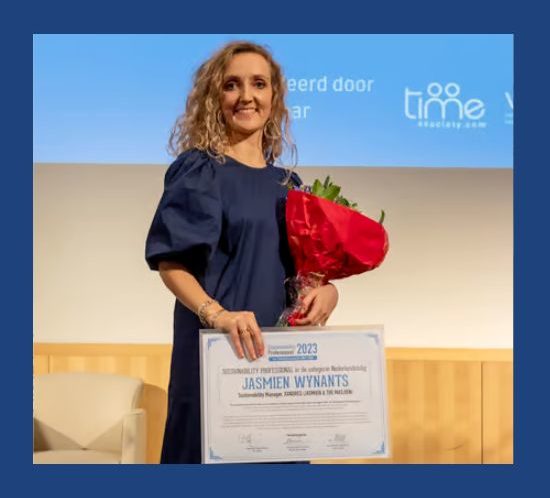
Jasmien Wynants sustainability professional 2023

Jasmien awarded Sustainability Professional of the Year 2023

Jasmien received the honourable ‘Sustainability Professional of the Year’ award in 2023.

Jasmien Wynants has been elected Sustainability Professional 2023 by a joint initiative of Time4Society and VBO FEB. The award is the final part of a selection procedure that started in November 2022.

The Sustainability Professional is someone who inspires, motivates and implements initiatives in the field of sustainability within his company or organization, according to the press release.

The jury selected three Dutch-speaking and three French-speaking finalists from a list of 230 professionals over several rounds. A final online vote was to announce the final winner.

The jury appoints Jasmien as a Sustainability Professional because in all her actions she has one goal in mind: making the fashion world more sustainable. Jasmien provides inspiring training, motivational talks, workshops and advice. She also writes for various trade magazines and is writing a children’s book about sustainable fashion.

“I am very happy with this award. Both large and small victories should be celebrated. This also contributes to the visibility of sustainability in the fashion sector, and we will continue to focus on this in the future.”

Jasmien competed against Wouter De Broeck, Sustainability Manager at Alsico, and Geert Aelbrecht, Chief People Officer, Group Sustainability & ESG Officer at BESIX.

Column by Ann for De Tijd : Blockchain makes business models more sustainable

A myriad of individuals converge at blockchain events, an occurrence not limited to Belgium. This technology finds application across domains, fostering sustainable practices in sectors like fashion while elevating creator recognition.

March 30, 2023 – De Tijd

My recent and forthcoming weeks orbit around the world of blockchain once more. A stint in Paris marked my presence at the Paris Blockchain Week, where I addressed the audience at an event spotlighting Metaverse Fashion Week (unveil more details through #MVFW23). Presently, I hold a slot among 35 speakers at the inauguration of Blockchain4Belgium, elucidating the profound impact of blockchain on diverse business paradigms

What consistently astonishes me is the sheer scale of these events. Paris once again beckoned 10,000 enthusiasts (merely three weeks post the NFT Paris event, which drew 18,000 attendees). Belgium, too, has embraced blockchain with fervor, boasting a professional cohort of about a thousand aficionados.

Thursday heralds a physical rendezvous, with 300 attendees assembling at Blockchain4Belgium, an initiative spearheaded by Mathieu Michel, the Federal Secretary of State for Digitization. Here, insights and requirements will be exchanged, paving the way for policy recommendations. The purview encompasses regulations, along with educational and sectoral support.

Blockchain, inherently a versatile technology, encompasses multifaceted applications. Notably, non-fungible tokens (NFTs) serve as ownership certificates within the blockchain realm. Naturally, cryptocurrencies like Bitcoin and Ethereum also have their role. My primary focus, however, pivots away from cryptocurrencies. I even believe it should be nearly invisible, a facet pivotal to seamless integration of blockchain technology into widespread business models. Increasingly, platforms offer dual payment options – cryptocurrencies and traditional fiat (euros, dollars, etc.).

Phygital. Blending the Physical and Digital Realms.

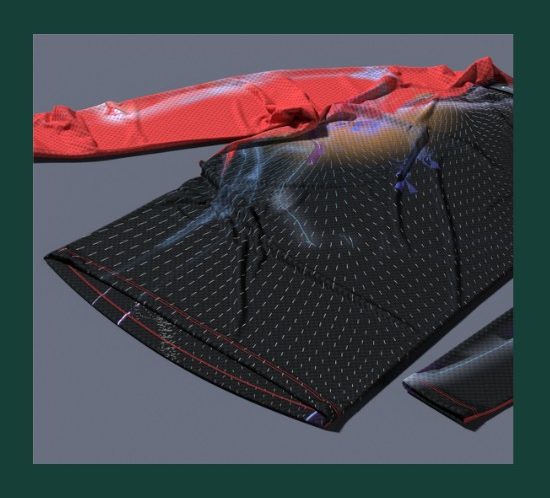
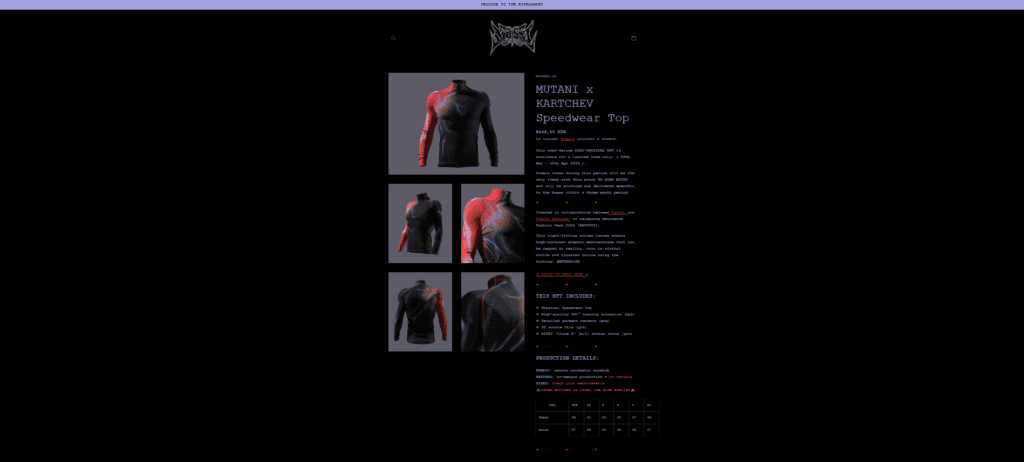
For Metaverse Fashion Week we are launching a phygital with Mutani.This entails the simultaneous purchase of physical and digital assets, intertwined through a chip. This unique offering graces an ordinary e-commerce venue hosted on the Shopify platform. Thanks to our partnership with Belgian Venly, NFTs are available in our webshop, including a design cycling jersey, attainable in both physical and digital formats.

The buyer pays in fiat and does not have to go through complicated procedures. Immediately upon purchase, the buyer receives the NFT and its digital iteration, accompanied by a blockchain-linked certificate of ownership for the physical jersey. All of this is bundled into a digital wallet, generated for the customer and delivered straight to their email inbox, streamlining the entire process.

For our designers, this marks an evolution in crowdfunding, an advanced realm where digital prototypes carry no carbon footprint, circumventing overproduction. The certificate of ownership establishes a precious rapport between the consumer and their acquisition, transforming it from a disposable item into a cherished possession. Furthermore, this certificate enables future resale, with designers garnering royalties. As the second-hand market gains traction, smart contracts ensure the original creator’s enduring involvement.

My curiosity is piqued regarding the cycling jersey buyers and their perception of the digital variant and accompanying NFT. As with any technological stride, adaptation to customer and corporate needs remains paramount. Government’s role, too, is pivotal, albeit a work in progress.

Article by Jasmien for Fashion United: How global warming and the fashion industry are inextricably linked

ON ‘Sustainability Clarified’ – a series of Jasmien Wynants for Fashion United.

In this series, we take you into the wonderful world of environmental science. Each article clarifies a key topic related to ‘sustainability’. We zoom out to the bigger picture and then look in more detail at how these complex concepts are linked to the fashion industry.

This time, we talk about… global warming.

October 11, 2022, Fashion United

Global warming, what is it?

It is important to distinguish between ‘global change’ and ‘climate change’. The latter is just one example of the many changes on our planet that we are aware of and falls in line with examples like ‘biodiversity loss’ and ‘nitrogen enrichment’.

Global change is nothing new. Consider the ‘continent drift’: the continents as we know them today did not exist in that form millions of years ago but stuck together. Those movements admittedly took millions of years to take place. Such changes had a lot of impact but were slow, whereas today’s climate change is happening much faster. Two major tipping points caused that acceleration, which is why we can now see the world changing before our eyes.

The first tipping point is found with the industrial revolution. In the eighteenth century, this made us much less dependent on human and animal power for heavy labour because machines could take over. In addition, the production of artificial fertilisers in the early twentieth century led to a huge increase in agricultural productivity.

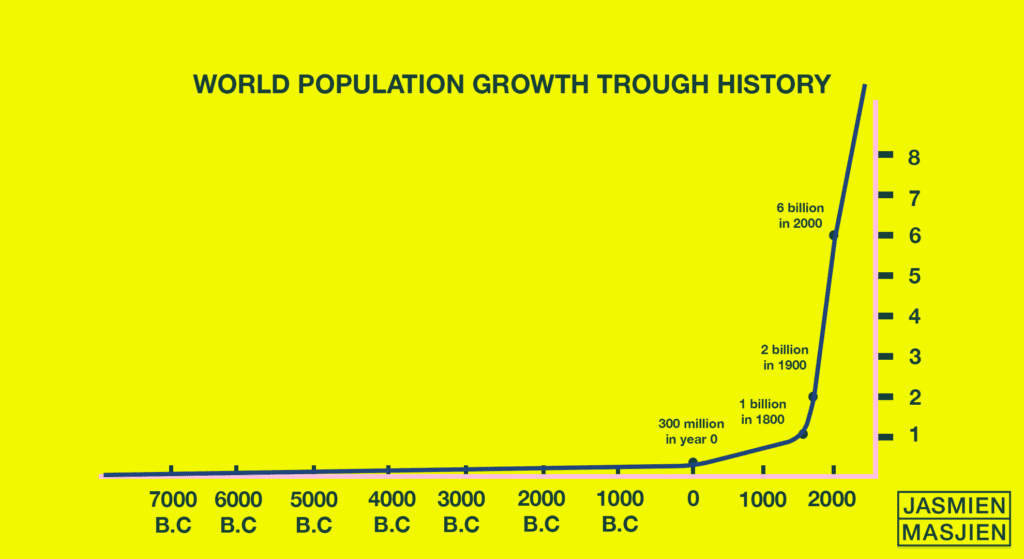
Together with a general advance in medical science, these “revolutions” allowed us to feed more mouths, and live better and longer. Population growth exploded, and that had consequences… Because more people means more CO2.

Global warming, what is it?

Humans live. We move around, heat our homes, switch on the lights, and we use fossil fuels to do so (oil, gas, coal, lignite). The enormous increase in population and the use of more and more machines (industrial revolution) have caused us to burn more and more fossil fuels. And it is precisely these fuels that cause rising CO2 concentrations … which in turn lead to global warming. The food industry and the fact that we have started eating more and more meat over the past 100 years are also major contributors to greenhouse gas emissions. Cutting down forests to make way for (food for) livestock releases a lot of CO2. (Plants and trees extracted and stored CO2 from the atmosphere for tens of millions of years. We now burn that CO2 and it all returns to the atmosphere in a very short time).

World Population Growth

The greenhouse effect: it’s not just CO2 that warms the earth

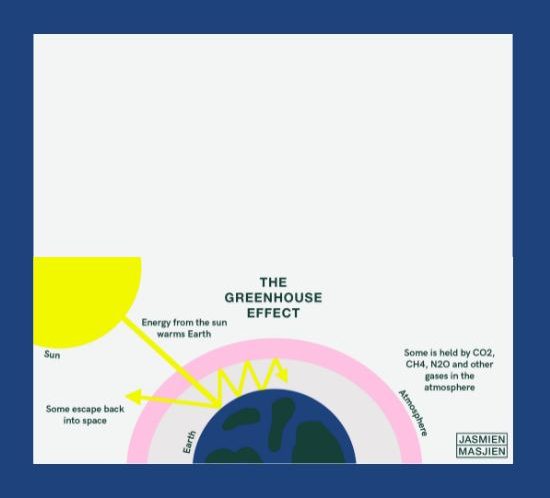
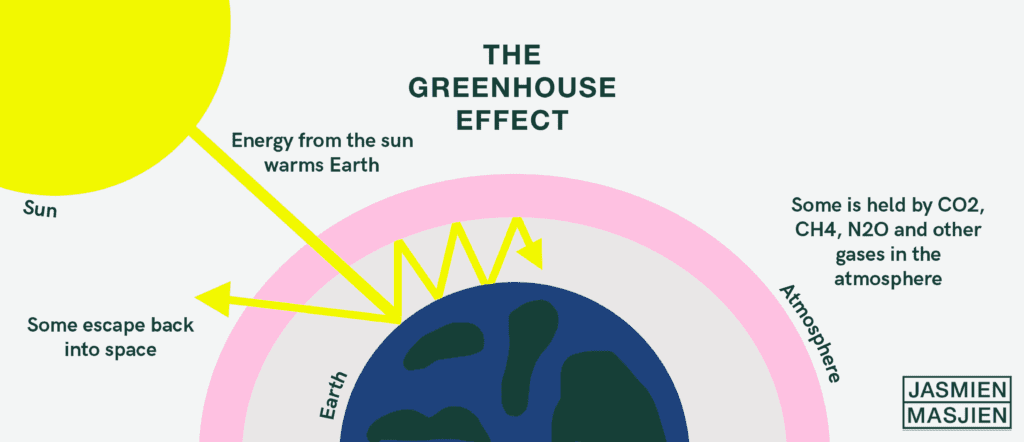
Just over half of global warming is caused by the increase in CO2 thanks to the famous ‘greenhouse effect’. Besides CO2, methane and nitrous oxide are also important greenhouse gases because they cause more warming per molecule. Methane comes mainly from agriculture (cattle are ruminants and emit methane in the digestion process, for instance). Nitrous oxide also occurs in agriculture but also in industry and traffic.

Greenhouse gases help the earth keep up with heat. And that is just as well. We know that without greenhouse gases, the Earth’s average temperature would be more than 30 degrees lower than now. And so our planet would be largely unlivable. But… the concentration of greenhouse gases has skyrocketed in recent years, trapping much more heat.

The Greenhouse Effect

This ‘greenhouse effect’ has more consequences than just global warming. The expected increase in extreme weather (drought, heat waves, downpours,…) is just one of the consequences. Entire ecosystems are put under pressure by climate change, there are shifts in seasons, impacts on fresh water, a strain on agriculture, rising sea levels, melting glaciers, flood hazards for low-lying areas, increased mortality from extreme heat, economic consequences, dehydration, wars, climate refugees,…

And the biggest danger? That’s what climate scientists call the ‘snowball effects’. There are many possible ‘positive feedbacks’ that we don’t all know about yet, but which it is estimated that ‘once set in motion, they are still hard to stop’. Like a ball that pushes you down a small slope and into a deep valley. To get that ball back down the slope, you have to push much harder than to get it moving initially.

The danger of the global temperature rise exceeding 1.5-2 °C is there… and climate scientists fear that we will then end up in a ‘hothouse earth’ that will be difficult to get out of.

So that 1.5°C, what about it?

So in 2015, world leaders at the Paris Climate Agreement agreed that the warming of our planet should be limited to 2 degrees (and preferably 1.5 °C) compared to pre-industrial levels. The 1.5 limit is an important one because it is the point at which climate effects will thus become increasingly harmful to humans and the planet. And some of those effects are also irreversible.

Unfortunately, the likelihood of faster global warming is increasing all the time. The World Meteorological Organisation (WMO) announced in May 2022 that there is a 48% chance that we will be at that 1.5 degree warming even before 2027. (The years before, that probability was assumed to be rather small).

And can we talk about fashion now?

There is a strong call for industry, governments, consumers, all of us to make a maximum effort to combat global warming. So the fashion industry also has a role to play in this.

According to the Ellen McArthur Foundation (A New Textiles Economy: Redesigning Fashion’s future), total annual greenhouse gas emissions from textile production are more than those of all international flights and shipping combined (1.2 billion tonnes per year).

The fashion industry emits a lot of greenhouse gases during the production phase, but it is also an international industry that sends parcels and containers all over the world to get clothes from the producing countries (often in the Far East) to shops and customers. Not to mention the amount of packages we order and return every day while shopping online.

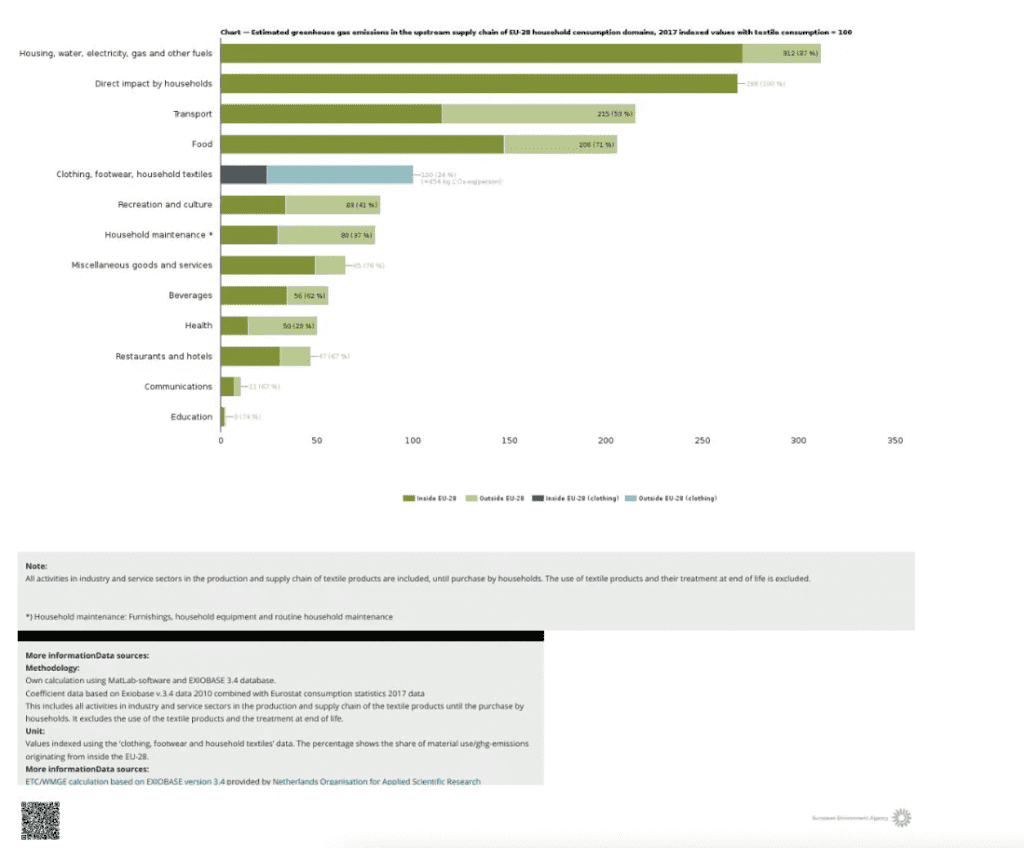
According to the European Environment Agency (EEA), textile production generates around 15-35 tonnes of CO2 equivalent per tonne of textile produced. Clothing, shoes and household textiles rank fifth in the EU in greenhouse gas emissions. This is more emissions than : recreation & culture, beverages, health, restaurants & hotels and communications, among others (Figure 3 from EEA below).

Activities in industry and service sectors in the production and supply chain of textile products included. Use of textile products and end-of-life treatment excluded. Image courtesy of EEA.

Not only does the use of fossil fuels in making and transporting our clothes lead to an increase in CO2, deforestation also contributes. Trees store carbon, but so when you burn them, that carbon is released back. When trees are cut down, the roots rot and the organic material is converted into CO2 and methane… which again leads to more greenhouse gas emissions. So every time we have to make space to grow livestock (both for food and leather) or establish cotton plantations, for example, this has an effect.

A lot of fashion companies are therefore now setting up ‘Science Based Targets’ (SBTs). This is part of an initiative by CDP, UN Global Compact, WRI and WWF whereby company targets are set to stay within the 2°C increase. Companies start by measuring their carbon footprint (Carbon Footprint) to get a better picture of where their major impacts are and how to reduce them. They then set concrete targets for their short-term and long-term emissions reduction strategy.

Finally, it is important to look not only at the industry but also at the fashion consumer. We then spontaneously think of how we can reduce our impact by washing, ironing or using the dryer less, washing at lower temperatures but also by cherishing our clothes for longer. After all, it is too bad to throw away a garment that required so many raw materials and fossil fuels after only a few uses?to the fashion consumer. We then spontaneously think of how we can reduce our impact by washing, ironing or tumble-drying less, washing at lower temperatures but also by cherishing our clothes for longer. Surely it is too bad to throw away a garment that has required so many raw materials and fossil fuels after only a few uses?

We asked the scientist… Hans De Boeck, Global Change Ecologist at the University of Antwerp 

“Keeping climate warming within limits, below +2°C and if possible below +1.5°C, is very important because scientists from all kinds of fields estimate that the negative consequences for people and nature become very large above these limits. Every sector will have to make a solid effort, including the fashion industry. This is not only necessary, it is also useful in the longer term for the sector itself, e.g. because energy costs can be reduced.”

“There is work to be done. The clothing sector is very wasteful: hardly any discarded clothing is recycled (< 1 per cent), and unsold products are still too often simply destroyed by incineration. Moreover, we buy more and more clothes, in the US, for example, 3x more than in the 1960s. Fast fashion is a minor disaster for the environment. Although it does not sound very appealing, the best ‘climate measure’ is simple enough to buy less new clothes. Other options for greening: consciously look at the fabrics used, with animal products like wool and silk grosso modo having a higher climate impact than plant-based ones like flax, hemp and cotton. Further: recycle and reuse more. Finally: putting clothes in dryers or ironing less or not at all, as both are energy-consuming activities. Clear indications on clothing about the climate and/or environmental footprint may be useful to raise awareness, although care must be taken to avoid greenwashing (selling something as environmentally friendly when it is not) encouraging consumers to buy ‘more’ anyway.”

Future Fabrics, what?​

Jasmien creator MoMu Fashion & Sustainability Walk

Jasmien created the Fashion & Sustainability Walk for MoMu Antwerp.
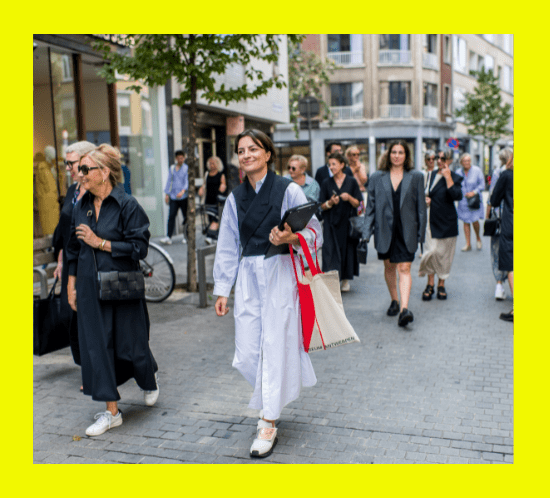
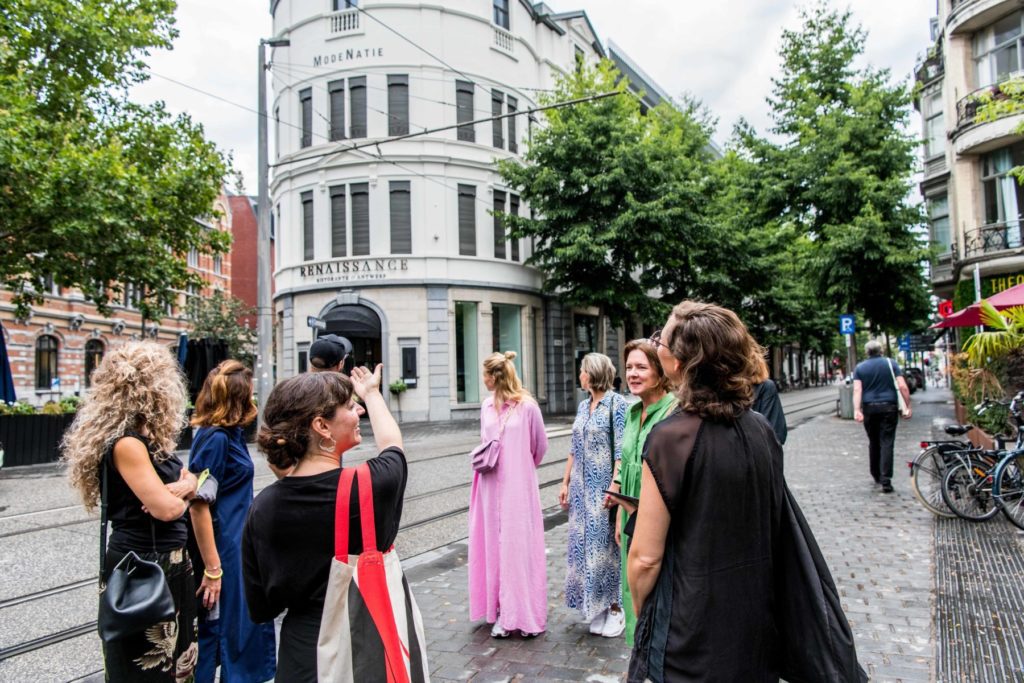
As from September 2022 you’re able to book the MoMu Fashion & Sustainability Walk. A guided tour that illuminates the many facets of sustainability across the Antwerp fashion scene. MoMu Antwerp asked Jasmien to map out this walk with them. This walk does not show where you can shop ecologically or which designers and labels are sustainable. We do want to show how principles of sustainability are ubiquitous and of all times and how to make people look at fashion from a new perspective.
The tour lasts two hours and takes you along the beautiful streets of Antwerp’s fashion quarter. You can book the MoMu Fashion & Sustainability Walk in group. Individual visitors can join the tours every second Saturday of the month.
Loading new posts...
No more posts