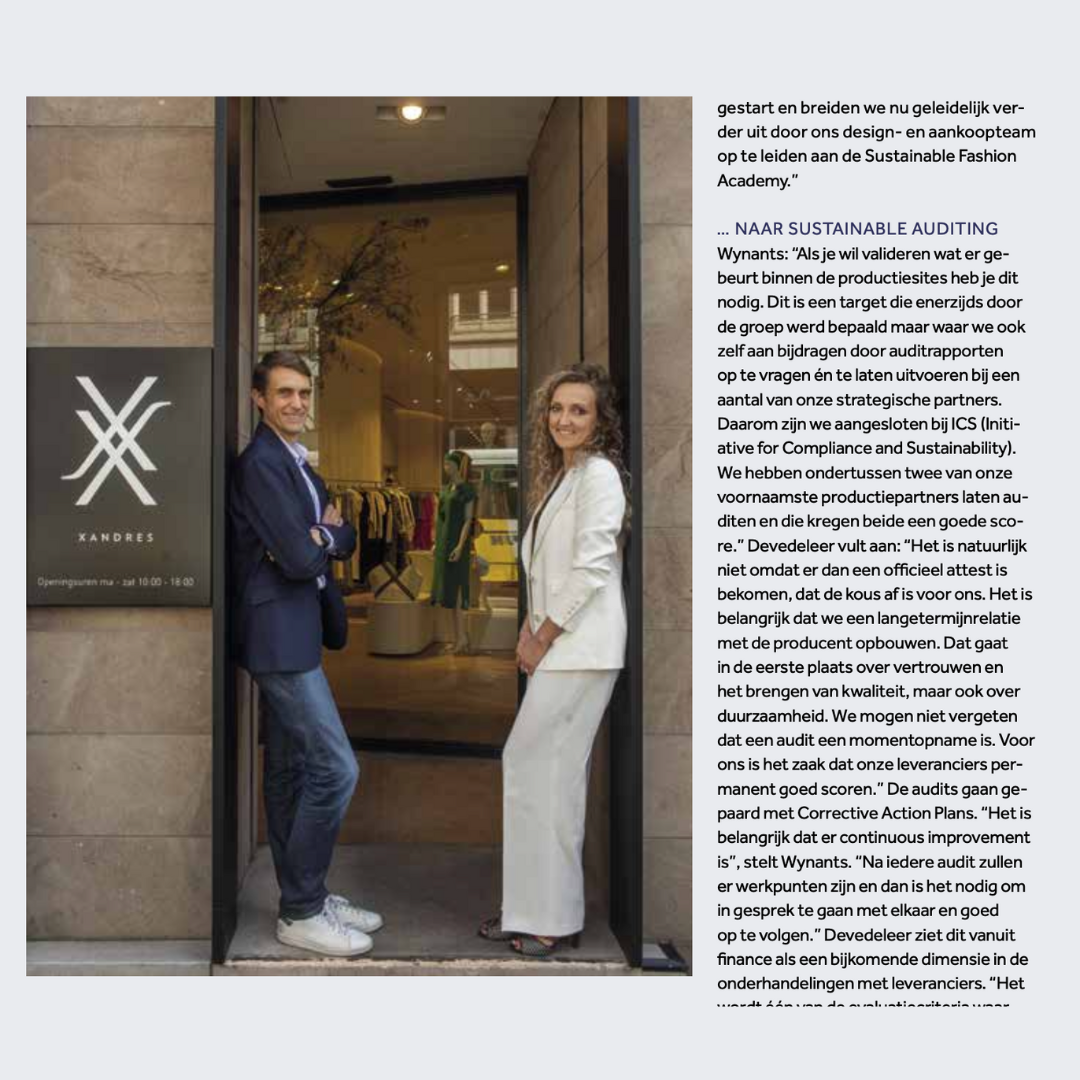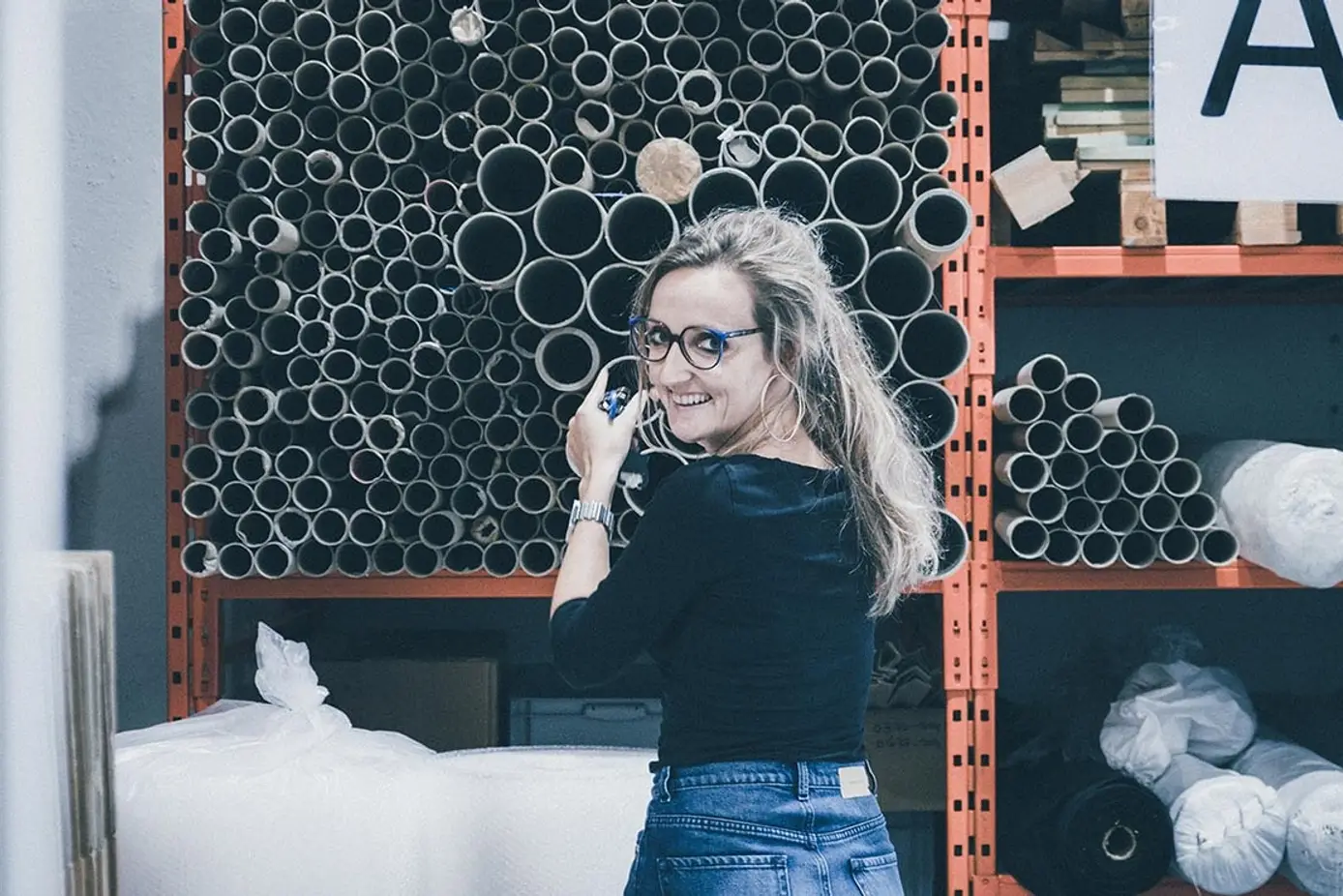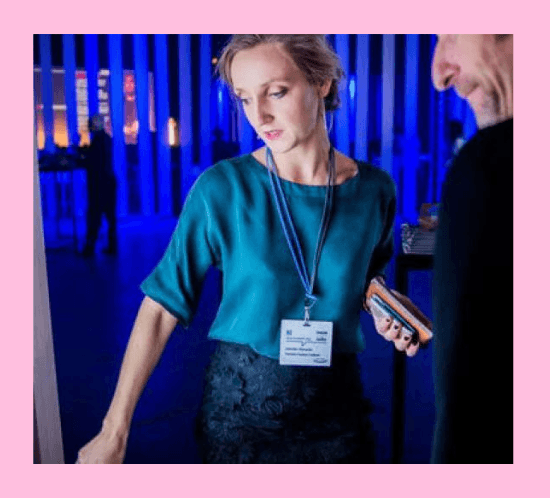
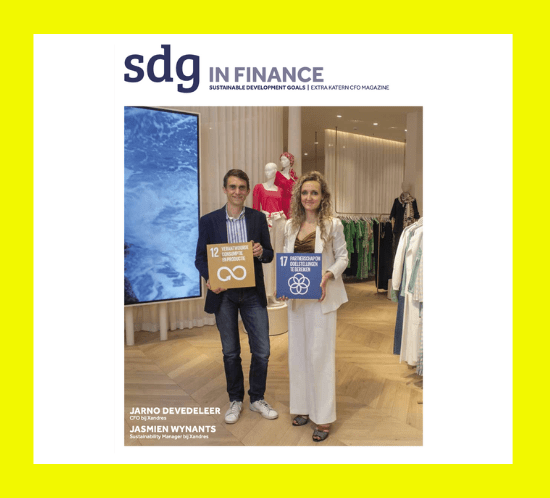
CFO Magazine in conversation with Jasmien and Jarno on sustainability & finance at Xandres.

Interview with Jasmien Wynants and Jarno Devedeleer (CFO Xandres) in CFO Magazine, written by Niels de Boysere

 Finance supports sustainable ambitions Xandres

Belgian fashion house Xandres published its first sustainability report at the end of 2021. Remarkable: the ambitions of shareholder Damartex Group are prominently featured but Xandres also managed to set goals and priorities from its own DNA. CFO Jarno Devedeleer and Sustainability Manager Jasmien Wynants explain.

Turnover: 25 million euros; employees: 110 
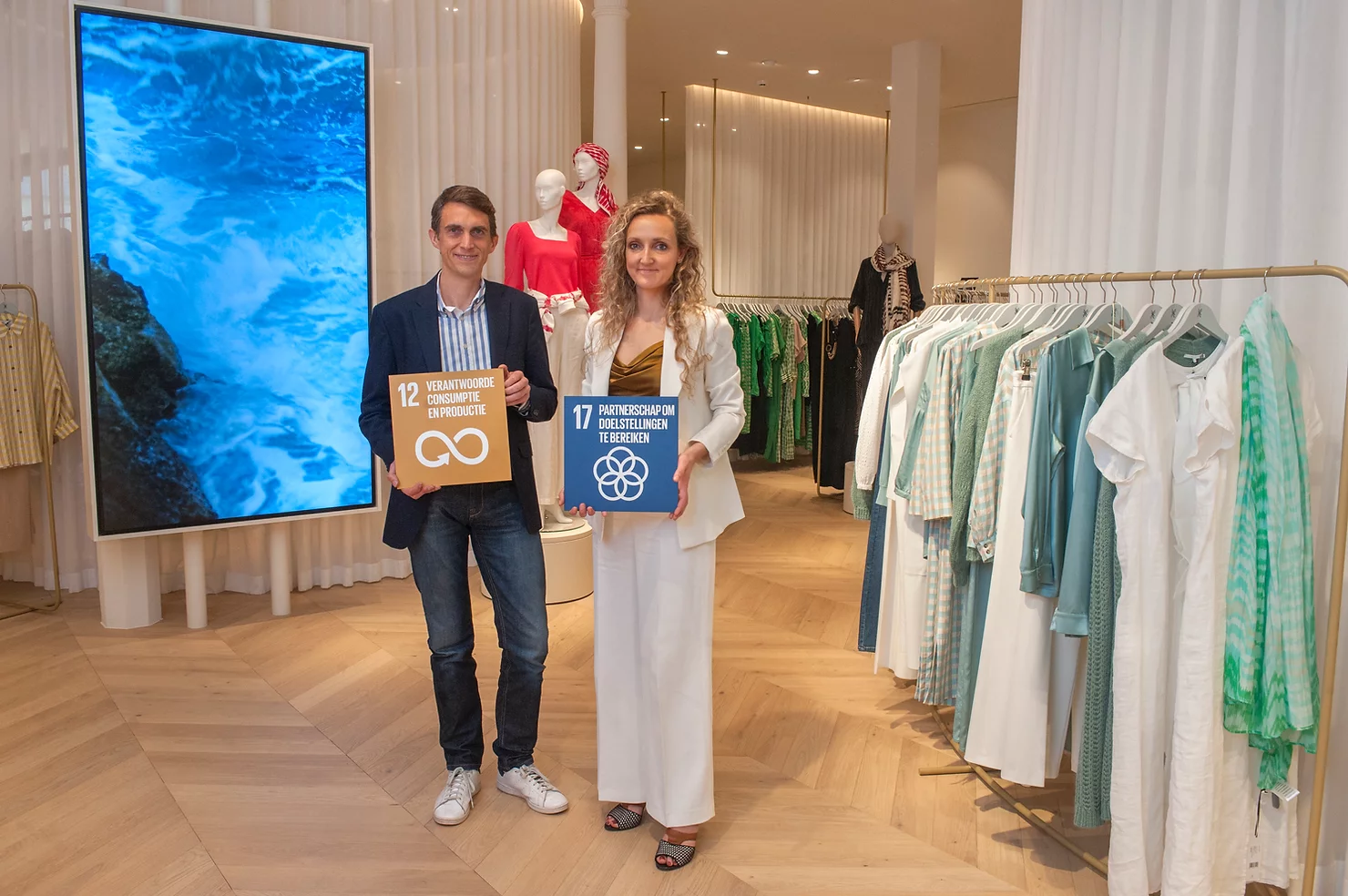
CFO Magazine - image: Jerry de Brie

At the end of 2021, Xandres launched its first sustainability report. Although the Belgian fashion house is part of Damartex Group, which as a listed company has been reporting non-financial information since 2016, it chose to outline its own sustainability path and also immediately included it as a strategic pillar. A conscious choice for CFO Jarno Devedeleer. “We have been working on the sustainability of our products and the production chain for some time,” he says. “That makes it possible to start choosing or prioritizing things from our DNA. Of course, we remain part of Damartex Group. And it has already formulated clear, strategic pillars for sustainability. So from a group perspective, there are different initiatives going on that inspire us but that happens just as much the other way around.

“Mandate at the highest level”

In order to make the sustainability ambitions a reality, a Sustainability Manager was recruited in early 2021. Wynants felt strongly about this trajectory and the ambitions of Xandres, so the collaboration was quickly successfully launched. “We chose to build our own strategic section on top of the already existing framework,” says Wynants. “To do this, we concretely looked at: who is Xandres and what is our identity apart from sustainability? This quickly led us to quality, craftsmanship, longevity, etc. We translated these issues into our own sustainability strategy, set our own objectives and produced our own report. The group has been an inspiration for this, but we have set out our own guidelines from within Xandres. Something like this has to come from the inside. If that is not the case, it is not ingrained enough in the company and the chance is too great that the subject will slip into the background too quickly. This all departed from management, which is precisely why it was given a separate mandate.”

From code of conduct at suppliers…

“We know that there are numerous things coming our way legislatively, without already having a concrete idea of exactly what everything will look like,” says Wynants. “And if you look at our various stakeholders, you see that we are being encouraged, especially B2B-wise, to act on this. We are doing this in the first phase of our sustainability strategy, for example, very concretely towards our suppliers. We developed a ‘framework for sustainable procurement’ to have a clear grip.” It is important to note that Xandres does not run its own production sites but rather works with production partners. Of those, 40 percent are located in Macedonia.

“Those production partners are asked today to sign a Code of Conduct as a first step towards a responsible supply chain. This indicates that there is no child labor, no exhaustive working hours or unfair working conditions. The Code of Conduct is a promise from them to us, and is based on the general principles of Corporate Social Responsibility. Step two was to train our procurement team so they would have the right information in order for them to ask critical questions of suppliers, have the right templates, … We started doing that last year and are now gradually expanding by training our design and procurement team at the Sustainable Fashion Academy.”

… towards sustainable auditing

Wynants: “You need this if you want to validate what is happening at the production sites. This is a target that was set by the group on the one hand, but which we also contribute to by requesting audit reports from a number of our strategic partners and having them carried out. This is why we joined ICS (Initiative for Compliance and Sustainability). We have since had two of our main production partners audited and they both received a good score.”

Devedeleer adds: “Of course, just because an official attestation has been obtained does not mean it’s a closed case. It is important that we build a long-term relationship with the producer. This is primarily about trust and delivering quality, but also about sustainability. We must not forget that an audit is a snapshot. For us, it’s about ensuring that our suppliers score well on a permanent basis.” Audits are accompanied by Corrective Action Plans. “It is important that there is continuous improvement,” states Wynants. “After every audit there will be working points and then it is necessary to have a conversation with each other and follow up properly.” From a finance perspective, Devedeleer sees this as an additional dimension in negotiations with suppliers. “It will be one of the evaluation criteria that will give us a lot more objectivity about the supplier,” he says. “For this, by the way, we have also adapted our ERP system because it adds quite a lot of administration for the purchasing team.” 
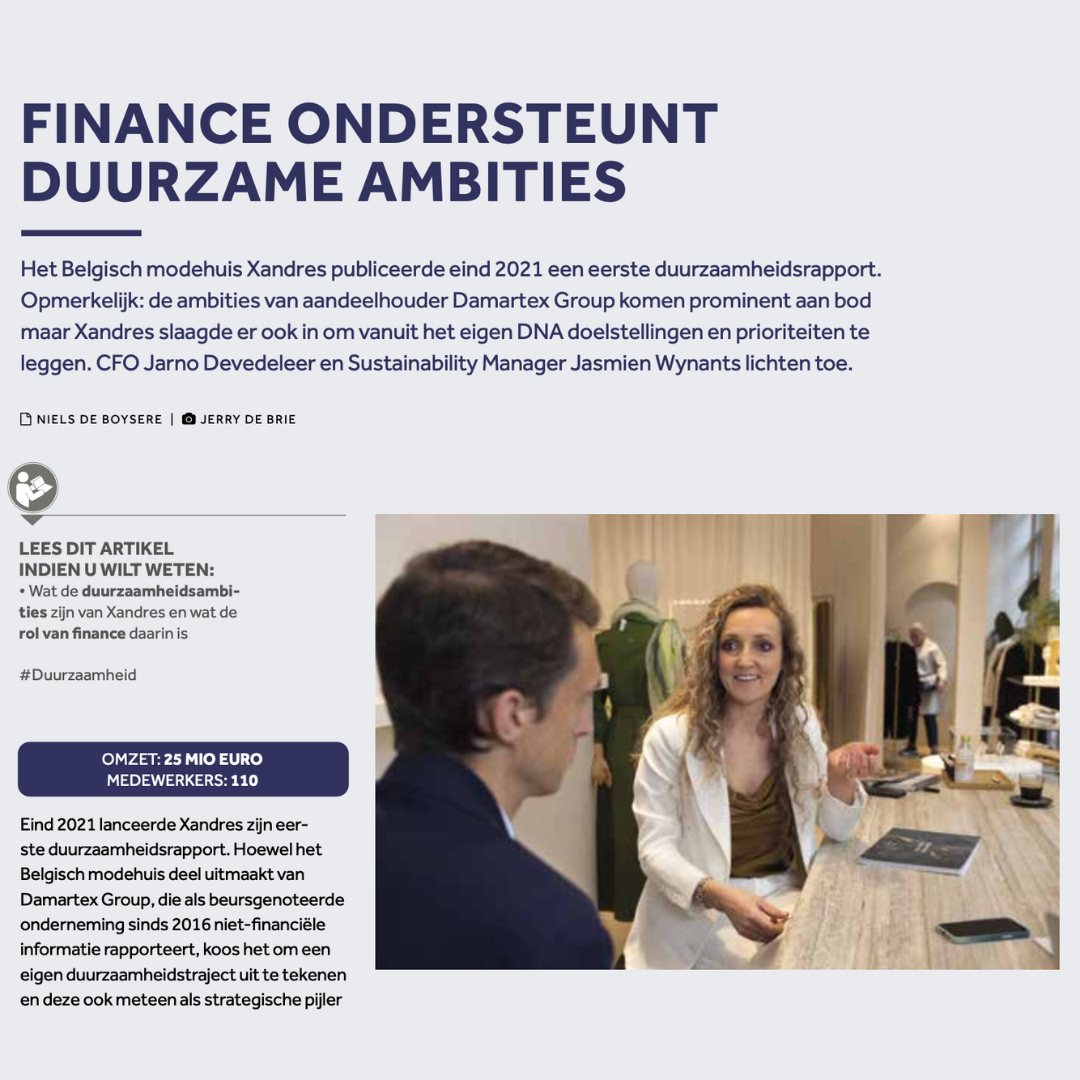
CFO Magazine - image: Jerry de Brie

CFO as a realist

“We know that there are numerous things coming our way legislatively, without already having a concrete idea of exactly what everything will look like,” says Wynants. “And if you look at our various stakeholders, you see that we are being encouraged, especially B2B-wise, to act on this. We are doing this in the first phase of our sustainability strategy, for example, very concretely towards our suppliers. We developed a ‘framework for sustainable procurement’ to have a clear grip.” It is important to note that Xandres does not run its own production sites but rather works with production partners. Of those, 40 percent are located in Macedonia.

“Those production partners are asked today to sign a Code of Conduct as a first step towards a responsible supply chain. This indicates that there is no child labor, no exhaustive working hours or unfair working conditions. The Code of Conduct is a promise from them to us, and is based on the general principles of Corporate Social Responsibility. Step two was to train our procurement team so they would have the right information in order for them to ask critical questions of suppliers, have the right templates, … We started doing that last year and are now gradually expanding by training our design and procurement team at the Sustainable Fashion Academy.”

CFO Devedeleer himself is mainly involved in the strategic process for a more sustainable company. “Our team mainly comes in to support reporting and setting the right KPIs,” he says. “As CFO, I then have to intervene myself in the balancing act between planet, people, and profit. Sometimes you also have to push choices if our result cannot support certain ambitions. Of course we want to be as sustainable as possible, and we might ask ourselves questions about the production of our clothing abroad… But in terms of cost efficiency alone, there is no doubt about that. Let alone the knowledge that has been acquired and the specialization, as well as the supply of raw materials. You would have to map out the entire chain again. In addition, you are sometimes forced to follow certain flows because of tax issues or customs problems. In addition, of course, I have to ensure that resources are freed up, because this process does have a certain cost. An additional cost. You have to be able and dare to set up this exercise as an organization. Do you charge everything to the customer if you only want environmentally friendly fabrics? And how do we finance all of this? Ultimately, this is a classic exercise that simply belongs to our role…”

“When we choose not to participate in actions like Black Friday but resolutely and permanently opt for Green Friday (counter-movement to the shopping frenzy on Black Friday, and an action against overconsumption and impact on the environment, ed.), this has a financial backlash. Nevertheless, we see this as a very positive story that we are very consciously choosing. This is an example where we are not just looking from financial criteria, but clearly throwing sustainability in the mix…”

“Daring to question the system”

Wynants is very clear about the usual suspect in sustainability, ecology,. “For sustainable fashion, we actually have to question the whole system. About a third of the ecological impact of a garment lies with the consumers. We have to systematically extend the life span so that we can get out of the fast fashion system. Sustainability is more than ecology. If you buy a T-shirt made of organic cotton and only wear it three times before you throw it away, wouldn’t you have been better off buying a non-biocotton one that you put on many times? We also see a role for ourselves as a brand there. We need to get our customers on board with this way of thinking. To raise awareness, we fall back on a Repair & Care program to give people tips on maintenance, on washing and ironing the article, but also, for example, if there is a hole in the clothing to have it adjusted. Xandres is also one of the few brands where you have a lifetime free repair. That too has come from the DNA of the company: we stand for quality and longevity and we want to go the extra mile in that.”

Devedeleer: “That’s a pure cost but of course we don’t leave it at that. It is important to make the most of the life cycle of a piece. In our flagship store in Antwerp, we are also currently testing an application where our saleswomen can see the clothing history of consumers and help them choose an article. If there are combination possibilities with an article that is already hanging in the consumer’s closet, we want to give that advice. In this way, we go against pure consumption but also contribute to extending the life cycle of a garment.”

Finally, Xandres is also deliberately entering into partnerships to bring more sustainable clothing into stores. “We believe in collaborations and so we seek them on different levels,” Wynants explains. “We have been in the Close-The-Loop network of Flanders Circular & Flanders DC since 2018, where we collaborate with other Belgian SMEs in the field of sustainability. We get inspired by companies who, for example, started their entrepreneurial story from a principle of circular economy. In this way, we also hope to have a further impact and to inspire others because, to be clear, we are not an eco-brand. However, that does not mean that we cannot do better year after year. For example, we set concrete goals in terms of increasing the use of materials with a lower environmental impact and set up collabs that we can learn from. For example, we currently have a collaboration with Raramuri, a Belgian sandal brand that has started to work with our residual materials and has them developed into new products in social employment workshops. Not only do we learn from this, we also give a small, unknown brand the opportunity to appeal to our target group and gain exposure for it. In this way, we are also trying to have an impact.”

About Xandres 

Xandres NV is a Belgian fashion company with a rich history of producing quality clothing for women from size 34 to 56. In 2016, France’s Damartex Group acquired Xandres’ operations. 

About ICS 

ICS is an international sector initiative to improve working conditions throughout the supply chain of retailers and brands. It consists of more than 65 multinationals from the textile, retail, footwear, electronics and furniture sectors. The members work together using the same tools to make audits reciprocal, thus combating ‘audit fatigue’, sharing knowledge and best practices. The audits themselves are conducted by ICS-accredited auditing companies but do not bring specific certifications or labels. Members do share the same rules when critical non-conformities are identified. The vast majority of ICS audits are partial or unannounced. Wynants: “Connecting our audits to ICS is a commitment we make. We do not know to what extent this audit, will become one of the mandatory audits for the textile sector and sustainability reporting. It’s hard to estimate but this will give us coherence with the expectations of the group.” 

Biographies 

JARNO DEVEDELEER has been CFO at Xandres since 2019. He started his career at EY and was successively in various finance roles, at Kinepolis, CDK Global, as well as one operational role Colruyt Group. At Colruyt Group he spent most of his career, over 9 years.

JASMIEN WYNANTS became Sustainability Manager at Xandres on 1 April 2021. Prior to this she worked for 8 years at Flandres District of Creativity. Wynants also holds the title of Circular Fashion Mentor at the Circular Economy Club, the international network of circular economy professionals. 
Interview for Trends on European Horizon2020 project SCIRT: ‘Recycling for the sake of recycling is not the solution’

Interview with Jasmien Wynants, Tom Duhoux (VITO) and Evelien Dils (VITO) in Belgian magazine Trends, written by Sarah Vandoorne.

Five Belgian and French clothing brands are joining forces with research institutes to put high-quality textile recycling into practice. From recycled discards they want to create and sell new designs. “Only if we work together is a circular economy achievable,”.

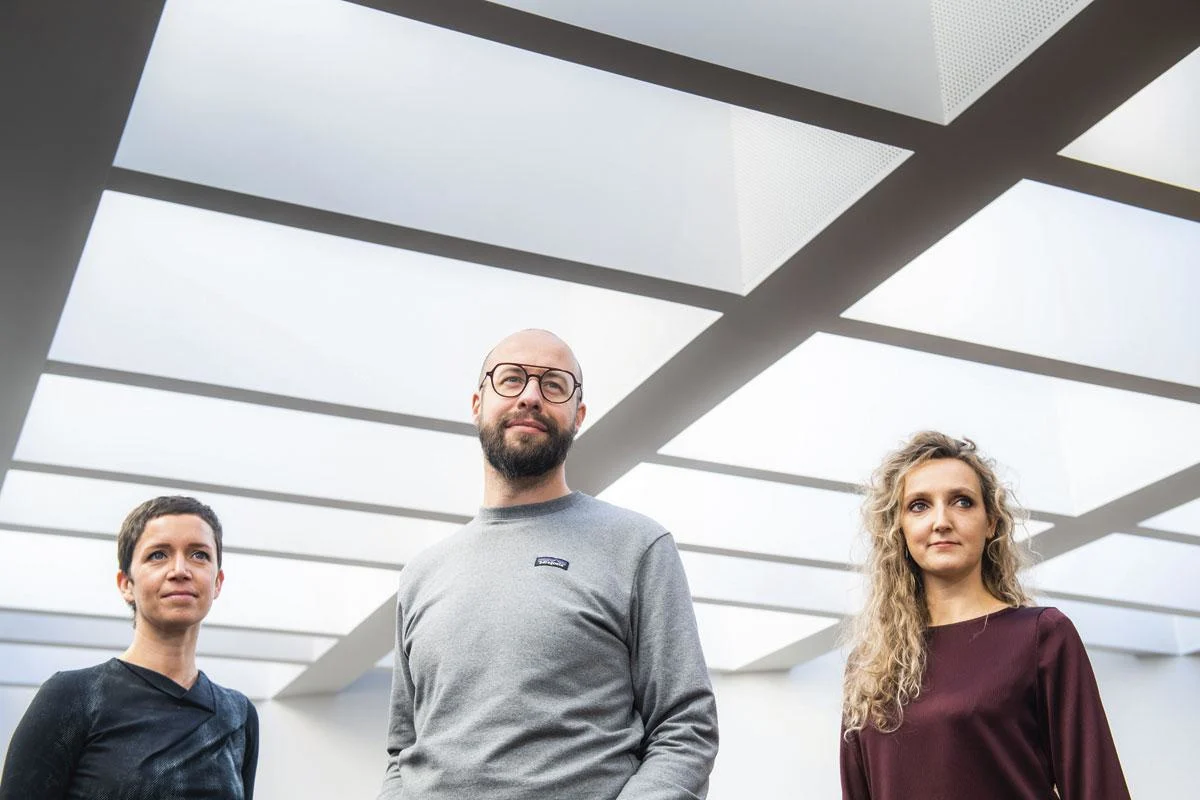
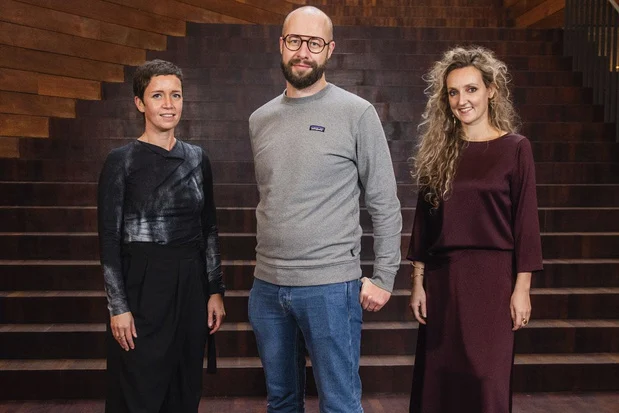
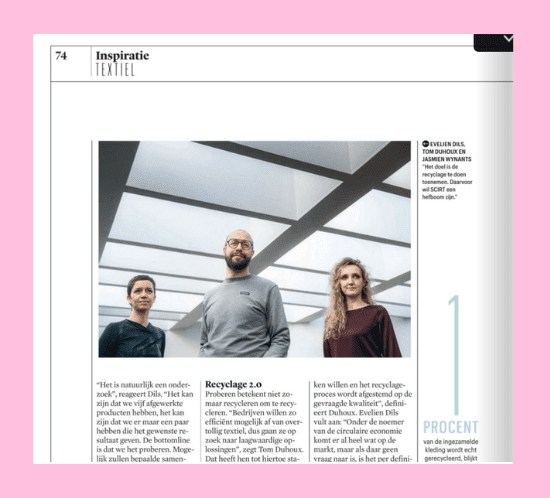
Evelien Dils - Tom Duhoux - Jasmien Wynants- image: Kris van Exel

It is a towering ambition: to recycle fibers that were until now considered unrecyclable. Yet it is the only ambition that matters, according to Evelien Dils and Tom Duhoux of the research center VITO and Jasmien Wynants, sustainability expert at Flanders DC. “By opting for less uniform clothing, we can bring about change,” says Jasmien Wynants. “Yes, we could have started a project to break down corporate clothing from one type of material, but then we would have been too unambitious.” We don’t participate in low-hanging fruit, says Evelien Dils either. “The European Commission wants to invest money to see what is possible, to push for change, see how far we can get.”

With European support, just before summer VITO, Flanders DC and other research institutions, non-profit organizations and SMEs from five countries joined forces with five Belgian and French clothing brands: Decathlon, Petit Bateau, Bel&Bo, HNST and Xandres. Their journey was christened SCIRT, which stands for System Circularity & Innovating Recycling of Textiles. Freely translated: textile-to-textile recycling.

Monomaterials
For years, industry specialists have been looking hopefully to the future of textile recycling. Although much is in motion, the basic premise remains deplorable. The process is expensive, energy- or labor-intensive, the supply is limited, and the quality is often inadequate because the process shortens the textile fiber. For the latter reason, each recycled fiber requires as much or even more new material to provide strength to the garment. With short, expensive fibers alone, you won’t get a quality product. The result? Less than 1 percent of all collected clothing is actually recycled, according to figures from the Ellen MacArthur Foundation. That’s not exactly hopeful.
Evelien Dils - Tom Duhoux - Jasmien Wynants- image: Kris van Exel

When progress is made in recycling, it often involves monomaterials. These are fabrics that consist of one type of fiber, such as 100 percent cotton, a natural fiber, or 100 percent polyester ¬ a synthetic fabric. A mixture of the two – the popular polycotton – is a lot harder to recycle. Never mind taking a mixed fabric of wool, polyester and elastane in hand, as Xandres does with a pair of pants in the study.

“Xandres uses that fabric mix frequently, which means that in the long run it would not stick to just one type of product,” admits Wynants, who in addition to her part-time job at Flanders DC assists the fashion house from Destelbergen as a freelancer. “I do wonder if the research institutes expect that all five brands will succeed in their objective, because that remains to be seen,” adds the sustainability expert.

“It is, of course, a study,” Dils responds. “It may be that we have five finished products, it may be that we only have a few that give the desired result. The bottom line is that we are trying. Possibly certain compositions will not get 100 percent recycled, but even then we can measure what percentage is maximally achievable.”

Recycling 2.0

Trying doesn’t just mean recycling for recycling’s sake. “Companies want to get rid of excess textiles as efficiently as possible, so they look for low-value solutions,” says Tom Duhoux. That has provided them with stability so far. They were able to process their waste streams at a reasonably constant speed into products of reasonably homogeneous quality at a reasonably fixed price.

“Recycling for recycling’s sake has never been the solution,” says Duhoux. He calls that mindset “recycling 1.0,” an outdated process. Low-value solutions are not exactly synonymous with circular. “Hence the need for recycling 2.0, where we look at what the brands want and the recycling process is tailored to the requested quality,” defines Duhoux. Evelien Dils adds: “A lot of things are already coming onto the market under the banner of the circular economy, but if there is no demand for them, it is by definition not circular.”

Investing in recycling takes time and money. “Only by working together is a circular economy feasible,” is Jasmien Wynants convinced. These are collaborations that did not just spontaneously arise, says Tom Duhoux of VITO. “Everyone seems to be waiting for each other. Is the demand big enough? Are the brands on board with this? I understand that an SME in, say, West Flanders, thinks: how can we contribute to this? But by bringing in all the know-how and supporting machine builders, we find solutions together.”

The bulk of the investments are for the machine builders, such as Valvan Baling Systems in Menen. That previously developed Fibersort, a machine that can check what composition a pair of pants or T-shirt has. Sorting clothing by fiber is an important stage before recycling takes place, SCIRT’s pilot project shows. An earlier 2020 report by Circle Economy, which conducted research based on data from the Fibersort technology, confirms this. “Machine builders like Valvan get direct contact with potential customers through our project. That’s interesting for them,” Duhoux points out. “The goal is to increase recycling. For that, SCIRT wants to be a lever.”

‘We are still at the stage where people are filling bags full of bargains every month or even every week every time they pass a Primark’ Jasmien Wynants, Flanders DC

Combination of techniques

Sorting is followed by recycling. In its report, the Dutch Circle Economy talks about mechanical and chemical recycling. The Belgian textile institute Centexbel also lists thermomechanical and thermochemical recycling. Together with the German Ecologic Institute, the research institutes from Belgium – Centexbel and VITO, two research partners of the European study DG Grow – looked into the advantages and disadvantages of each technique. Classic mechanical recycling weakens the quality, innovative chemical recycling weakens the quantity. Especially the latter technique requires a lot of money and energy. Thermomechanical recycling requires less input, both financially and ecologically, but you can only achieve it with dark fabrics of the same composition. The technique is very sensitive to fiber contamination, so discards are not a thankful input source.

“This study is not a final report,” warns Duhoux. It is not a classic ranking, he emphasizes. But what is the solution? “All technologies in combination, tailored to the desired end product,” the researcher concludes. “In large volumes, mechanical recycling continues to have its place, despite its drawbacks. In small volumes, as with SCIRT, we are more likely to look at other, less traditional forms of recycling.”

Before scaling up, therefore, a reduction stage is needed. This is precisely why the researchers are working with a limited number of brands to conduct research. “This is not just a production issue,” Dils adds. “It is not our intention here to just produce five garments once and be done with it. In addition to the technology, we are also focusing on measures that will make the transition financially feasible.”

No greenwashing

High-quality recycling requires investment, Dils knows. Policy plays a role in this. In Belgium, it is mandatory to collect textiles separately. From 2025, it will be mandatory throughout Europe. But designers, brands and consumers also have to be on board. Dils: “In terms of consumption, little has changed in recent years, despite all the communication. That’s why we make new garments from discarded goods, so-called post-consumer textiles.”

That too is an ambitious goal, Jasmien Wynants believes. “You can also manufacture preconsumer textiles, from unsold garments and production waste. But then you miss out on an enormous amount of textile.” Designers today are admittedly focusing more and more on recyclable design, notes Flanders DC’s sustainability expert. “But those are clothes that should only be recycled in five or ten years. Until then, we’re stuck with everything that’s already made. We’re still at the stage where people fill bags full of bargains every month or even every week every time they pass a Primark.”

There are companies with a lot of manufacturing waste. They can repurpose that and then claim that they are working with recycled raw materials. But that seems to me to be quite a perverse effect’ Tom Duhoux, VITO

“We are focusing on post-consumer textiles because that amount collected will only increase,” says Tom Duhoux. “It’s good to start thinking now about how we can recycle non-reusable textiles to the highest possible quality.” A useful side effect is that consumers and brands are also sensitized in this way.

An asset of a project like SCIRT is that it tries to avoid greenwashing companies. “There are companies with a lot of production waste. They can reuse that and then claim that they are working with recycled raw materials,” Duhoux believes. “But that seems to me to be quite a perverse effect.”

1 percent of collected clothing is actually recycled, figures from the Ellen MacArthur Foundation show.

Expert opinion for article in Knack Weekend: How sustainable are second-hand clothing platforms like Vinted really?

Article including Jasmien’s expert opinion in Belgian magazine Knack Weekend, written by Merel Thiers

Online second-hand clothing platforms such as Vinted, Vestiaire Collective and Depop have seen explosive growth in the last year. The benefits are many: you make room in your overflowing closet while giving items a second life and earning money on the side. But are the platforms as sustainable as they like to make out?

Vintage has long since shed its dusty image, but the second-hand clothing market seems to be booming like never before. According to large-scale research by online secondhand store thredUP, the secondhand market will double in size by 2025, meaning that it is growing eleven times faster than the regular clothing market. Online resale platforms, where you can buy or sell second-hand clothing, are meanwhile mushrooming. The online second-hand platform Vinted is the unsurpassed front runner in our country. The Lithuanian company settled in Belgium in 2018 and can now count on more than a million Belgian users.

Larger chains are not letting the second-hand trend pass them by and are jumping on the bandwagon by setting up their own second-hand platforms. Zalando, for example, expanded its offer with a “pre-owned collection” and H&M launched its second-hand fashion platform “Sellpy” at the beginning of June. In both cases, the platforms largely take care of the sales, while the users simply send the clothes. At Zalando you can exchange your credit for a Zalando gift card or donate it to charity, while from Sellpy you get a percentage of the proceeds.

Two sides of the coin

The benefits of second-hand clothing platforms seem to be self-evident: you make room in your overflowing closet and give items a second life while still earning something yourself. In other words, you bring clothes back into circulation instead of throwing them away or letting them gather dust in your closet. On the other hand, buying a second-hand garment is also good for your wallet. According to sustainable fashion platform COSH, in addition to saving money, you also save an average of 1 kilogram of waste, 3040 liters of water and 22 kilograms of CO2. The second-hand platforms are happy to play their part in the evolution towards a more sustainable, circular clothing industry.

Yet critics question this sustainable role. Business of Fashion writes that resale platforms may just be fueling “binge shopping,” by providing a market for quickly discarded items. Melissa Watt – ethical fashion journalist and author of “Not What It Seams,” a newsletter on fashion and sustainability – also believes that resale platforms mimic the fast fashion cycle. After all, the model is equally dependent on a constant influx of new items, most of which are barely worn. This is also evident on Vinted, where most items are sold under the label “unused without a price tag” or “little used. According to Watt, users wear a garment once or twice and resell it, after which other members buy the trendy pieces for a fraction of the original price. ‘This way it is easy to get caught up in an endless treadmill of trends. In other words, online reselling can unintentionally feed our disposable relationship with clothing,’ she writes.

Hilde van Duijn, an expert in the field of sustainable textiles, fears that the second-hand platforms will be used by chains as an excuse to ‘consume even more cheap clothes with a clear conscience’, she told de Volkskrant. Fast fashion chains like H&M and Zalando seem to offer their customers a ‘guilt free’ alternative: a golden mean between fast fashion and real awareness, which still binds the consumer to them.

According to Jasmien Wynants, sustainable fashion expert at Flanders DC, the issue is twofold: ‘If you can give something a second or third life – whether through second-hand sales, swapping, swishing or swapping – then you extend the life of that garment, of the energy and of the raw materials that were needed to produce it. So you are always reducing your impact on the environment when you resell a garment instead of throwing it away. But if it is an excuse to just buy something, wear it once, and resell it, then you can question its sustainability as a whole. However, it is not that simple to find out those motivations’.

Consumer also responsible

Marie-Julie De Bruyne is a PhD researcher at Ghent University and studies customer engagement in the circular economy. She agrees that the question requires even more research, but emphasizes the role of the consumer, in addition to that of the companies themselves: ‘We need much more than just the value chain to be as sustainable as possible. In the case of resale platforms, where users are not only consumers but also sellers, the user plays a crucial role to effectively achieve the sustainability objective’.

De Bruyne states that according to research, the economic benefits in clothing alternatives are still the main motivator for most consumers. ‘If they then buy second-hand at a slightly lower price, consumers naturally have more money available to possibly buy more. Then you see that the intention of giving a second life to one garment, might be giving life to several new garments, which negates the positive effect. Also, if you buy a lot of second-hand clothes but quickly throw them away and don’t bring them back into the circle, there is a limit to sustainability’.

According to research by Vestiaire Collective, second-hand platform for luxury goods, buying new items was found to be the main driver for thirty percent of sellers. Similarly, The RealReal, also a luxury second-hand platform, indicates that the majority of their sellers use their commission to store in the regular clothing market. With models like Zalando’s, where you get a Zalando gift card in exchange for your discarded garments, one can wonder to what extent that will lead to the purchase of a new item on the webshop, rather than a second-hand one. Jacintha De Graaf, head of Zalando Benelux, says of their pre-loved collection, “We know that our customers like to make sustainable choices and exchange items they no longer wear to make way for something new.

Alternatives

So what should we look for in resale platforms? After all, according to a recent Finnish study, reselling clothes is still the most sustainable option, compared to other alternative options like recycling or renting clothes. It seems that, as consumers, we should be especially aware of our own motives and where we (re)invest our money. ‘Of course it is still best to buy less but more qualitative and take care of your clothes,’ says Jasmien Wynants. After that it is best to give your clothes a second life in your own environment, through acquaintances or Swishing exchange events for example. That way you keep the chain short and you don’t need a middle man or extra transport.

Niki de Schryver, founder of sustainable fashion platform COSH! agrees: ‘Vinted is actually a spin-off from a transport company. That transport of course has CO2 emissions, and a big disadvantage is that before the sale you don’t know how far the garment will eventually go’. COSH! developed a step-by-step plan that helps you make choices when donating or selling clothing. Via their overview of recognized clothing and textile collection points, you know where your donated clothes will end up or at which local second-hand sales points you can resell your clothes.

Concrete tips for sustainable second-hand shopping:

Go through your closet again and ask yourself how you can wear or combine certain items in a new way. Can you still repair, adjust or upcycle the item? If you really want to get rid of it, first ask yourself if someone in your environment would like to take it over.

Do not buy an item just because it is second hand or cheap, but think carefully about what you buy. Most platforms allow you to save items, giving you another night to think about them.

Pay attention to the location of the seller and buy as locally as possible. You can specifically track sellers in your area and even meet in person to eliminate transportation.

Ask for measurements of the garment to avoid unnecessary returns. One brand’s M is not another brand’s M. As a seller, you can take on-the-fly photos and list your measurements so buyers can better judge how a garment will look on them.

Read a seller’s reviews to avoid scams and other woes. Beware, for example, of drop-shippers: sellers who resell new products, often from Asian webshops such as Shein and AlieExpress. The products are often fake and anything but durable.

On many platforms you can already enter filters such as sizes and brands for the items that appear in your overview. If you are looking for a specific item, you can enter search filters. The result: less aimless scrolling and a lower risk of impulse purchases.

At Vinted you can indicate Homerr as a shipping option. Homerr uses collection points and existing routes of logistics service providers. It sometimes takes a little longer for your package to arrive, but it is much more sustainable.

Op-ed on COVID & fashion by Jasmien: That one push. That one glimmer of hope.

Opinion piece on COVID, fashion & sustainability for Sarah Vandoorne, Ontketing.

June 12, 2020

Words. They are quickly written and even more quickly said. Sometimes we attach too little importance to them; or in my case too much. If you ask me about the current crisis, what I think about it and what I think the future will look like, I am afraid to speak my mind. Quite frankly: putting them on paper in black and white terrifies me.

When you asked me to “briefly answer these three questions for your series”-which to me is a best case, worst case and most realistic scenario for the fashion industry after corona-you no doubt had no idea what war you were unleashing in my head. Of course, like everyone else, I pause to reflect on this alienating situation and reflect on the future. But writing down my ideas in a simple ‘question and answer formula’ is not the same as musing about them with my husband during the daily aperitif. Because let’s be honest: nobody knows what the future will bring.

Words. They play an important role in this crisis. We use them to comfort each other from a distance or to congratulate on paper. I listened in amazement to the new words that emerged; each one hauntingly beautiful and just hauntingly at the same time in their layering. ‘Huidhonger’, ‘whatsapperitief’, ‘balconversatie’, ‘toogviroloog’. They illustrate what we want to and can’t do, what we creatively bridge and how we yearn for the truths and certainties we thought we had before.

Words. The ones you use the most or that are most important to you depend on where you were born, how (and if) you make money, who your parents are, whether you are a parent yourself, and whether your health allows you to lie awake over anything else.

I haven’t done much complaining in the past few weeks. There’s a simple reason for that. The words ‘poverty’, ‘illness’, ‘fear’, ‘uncertainty’, ‘cold’, ‘hunger’ or ‘survival’ do not dominate my daily life.

The words that do dominate here are ‘slowing down’ and ‘reflection’. These words often surface in my ‘bubble’ – in conversations with colleagues, friends and family, or in the articles, webinars and podcasts that come to me daily. And if I do try to formulate an answer to your question “How I hope the fashion industry can change after Corona?”, I hope these 3 words are the base for it.

We have known for some time that the fashion system faces great challenges. That was true even before Corona. The pace at which the industry must run is unsustainable; not ‘sustainable’ in the long run. We saw much earlier that there are ever greater and pernicious challenges surfacing throughout the chain. More and more designers are undergoing creative crises due to the constant pressure of the ever-shortening seasons. The system of mass production (and consumption) is depleting our resources and mercilessly testing the limits of our planet. We also have known for a long time that this same system takes its toll on the producing countries, where textile workers are underpaid and produce under inhumane conditions clothes that we (often without thinking about it) degrade to rags when a new color or print is ‘in fashion’.

It is very painful to see that a lot of fashion companies are now in an extremely difficult position and there are a lot of bankruptcies looming. I don’t want to make light of that: my heart bleeds when I think of the people behind the brands who have put heart and soul into their own business. But I cherish hope that the ‘shit’ that is now heading our way, can be the manure to finally grow towards a better fashion system. Designers and companies called earlier to seize this moment to review the fashion calendar and reboot the system in a different way. With more de-stressing. With perhaps a little less, and somewhat slower, but a little better and with the space to breathe. With the space to market creations that respect boundaries of the planet and the people on it.

‘I cherish the hope that the “shit” that is coming at us now can be the manure to finally grow towards a better fashion system.’

So best case scenario, Corona is now the catalyst that was needed to redefine the industry. Worst case scenario, we miss that opportunity and choose to remain stagnant and literally go further backwards. If we do not succeed in making a real effort now.

Article by Jasmien for Fashion United: Future Fabrics Expo 22

Article by Jasmien for Fashion United on fabrics that make the fashion industry more sustainable.
This year the ‘Future Fabrics Expo’ blows out ten candles. For a decade now, you can visit London every year to discover the latest developments in sustainable fabrics. Curious about the highlights? We are pleased to list them.   The tenth edition of the Future Fabrics Expo took place on 28 and 29 June in London.

Future Fabrics, what?​

That the fashion and textile industry contributes quite a bit to the climate problem is no secret. The fabrics that are used by the industry to make clothes often have a huge environmental impact. Cotton and polyester together account for about 80 percent of the clothing we wear, according to Textile Exchange’s Preferred Fiber and Materials Market Report 2021. Cotton requires an enormous amount of water (and pesticides) to grow, resulting in the drying of lakes and disappearing of nature and biodiversity. The production of polyester, on the other hand, requires a great deal of energy. Moreover, this material is made from oil and thus also contributes to the depletion of this non-renewable resource.

More and more brands and designers are therefore looking for better alternatives to the most commonly used materials. And that is where the Future Fabrics Expo comes in. It is the largest expo dedicated to sustainable and responsibly produced materials. You can find both commercially available fabrics and discover the latest innovations.

Inspiration from nature

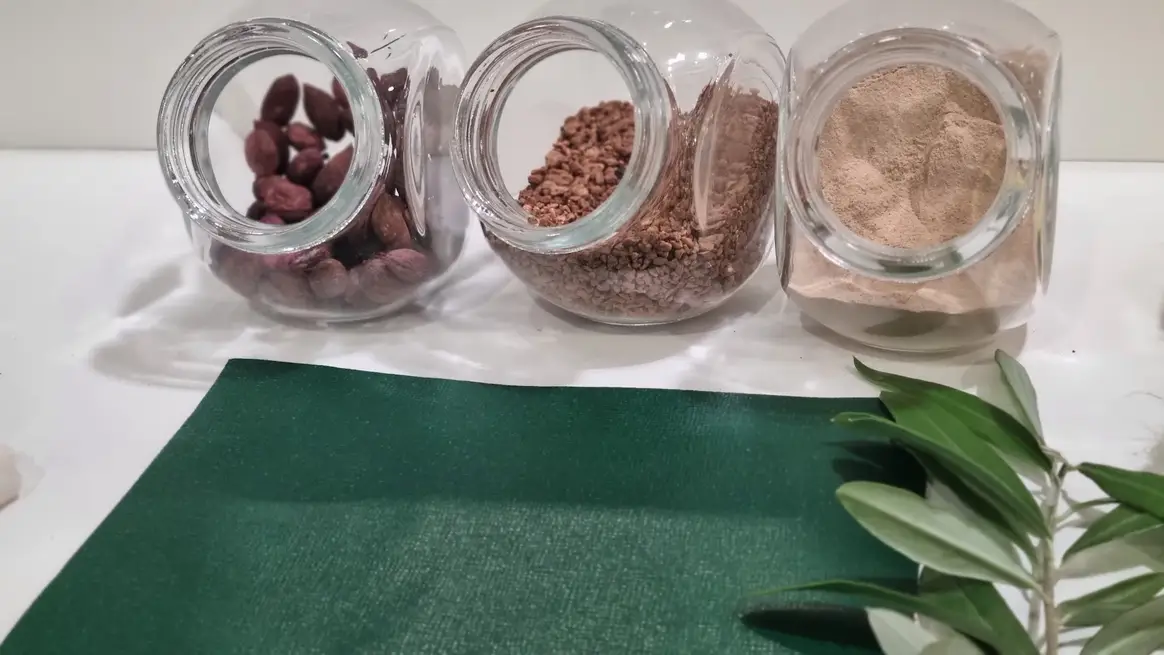
Many of the innovations that are currently in the development stage take their inspiration from nature. Italian company EMM, for example, has developed a synthetic alternative to leather that is partially (20 percent) made of olive stones, a by-product of the olive oil industry. The base of the material consists of recycled cotton. Bananatex ®, in turn, is made from the Abacá banana plant. This textile is manufactured without pesticides, fertilizers or extra water and has made a lot of progress since its launch in 2018, with a ‘Cradle to Cradle Gold’ certificate last year as the icing on the cake.
Emm synthetic leather with olive stones

Deep in the sea…

Fabric Sourcing Consultant Annet Sunderman specialized in sustainable textiles in recent years and has, for example, already worked with Bananatex ®. She indicates that innovations like this are important for the industry. “Besides fibers like these, I see especially a lot of developments with algae at the fair this year. I really believe that we can expect a breakthrough in that pretty soon.”

She refers primarily to ‘Seacell’, a patented material made from seaweed from the fjords and cellulose from sustainably managed forests.

“It’s really tremendously soft to the touch, but it’s still pricey.” And with that, Sunderman immediately identifies one of the tricky points. More sustainable materials often have a higher price tag, which is currently delaying their breakthrough. On the other hand, regular fabrics are also rising in price. Cotton, for example, is becoming increasingly scarce with the well-known financial consequences.

Waste becomes raw material: how about recycling?

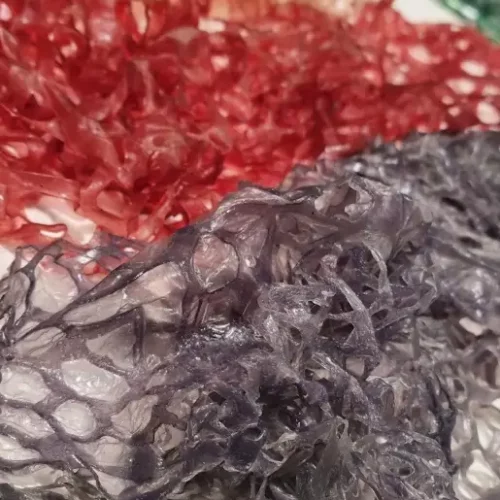
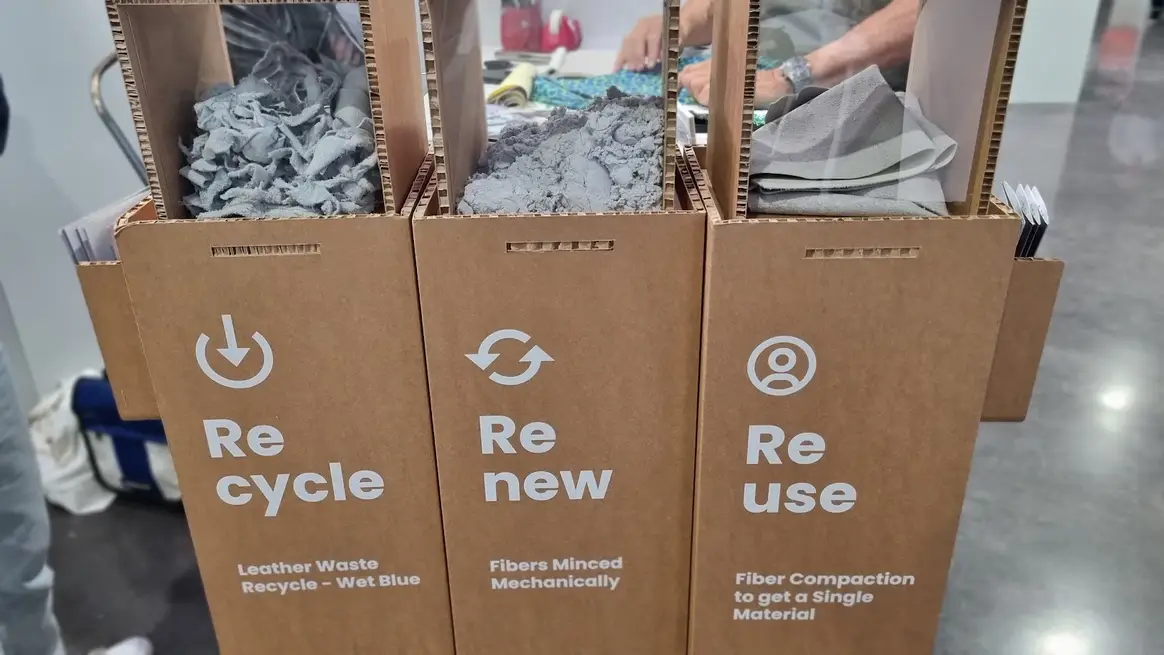
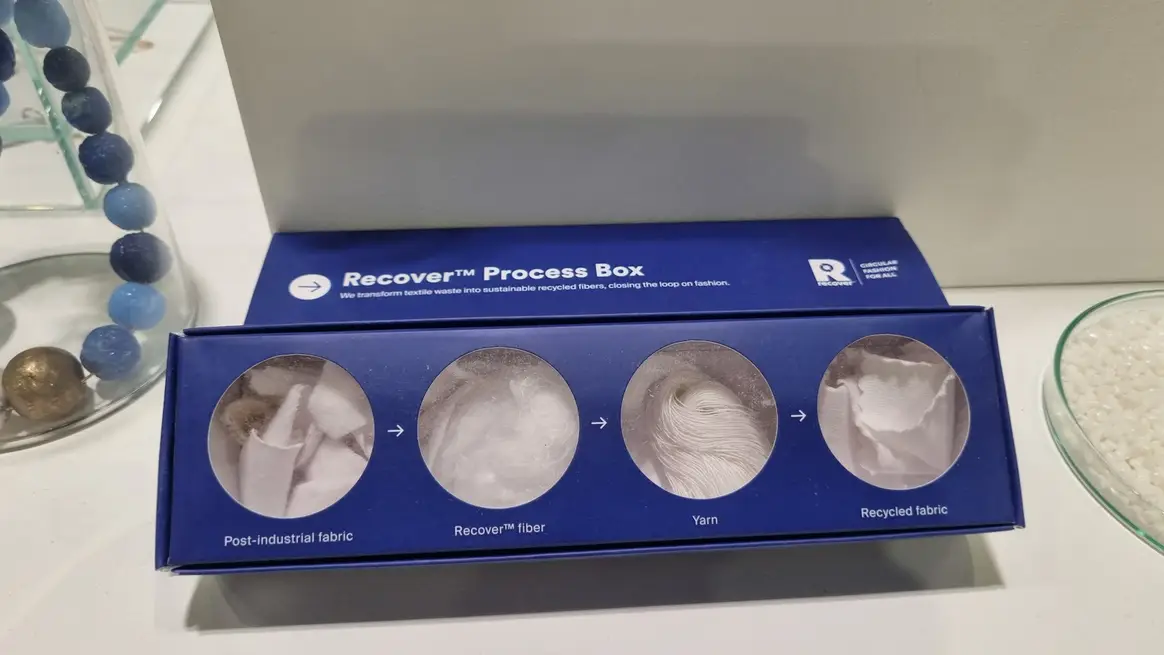
Not only the ‘bio-based’ solutions are represented at the fair, also recycled materials remain important in the race to use less ‘virgin’ (new) fibers. Besides a lot of recycled fabrics which you can find in the hall with commercially available fabrics, you can also get to know a lot of new projects in the innovation corner. ByPell® – the company that collects waste from tanneries to make recycled leather – is just one example. Recover™ draws on more than 70 years of recycling experience to offer a range of solutions for cotton.
ByPell ® recycled leather
Recover™ recycled cotton

So, tomorrow we’re all green?

Innovations take time. That is the case for every industry. A whole number of players at the fair therefore come back year after year to show progress. And the sector does progress, but for a lightning-fast industry like fashion, the pace sometimes seems slow. It therefore requires a different mindset from buyers and designers: taking the time to explore and test new materials is crucial.

Lieve Vermeire, Sustainability Manager at listed Belgian lingerie company Van de Velde agrees: “The expo gives a good overview of what is already commercially feasible and scalable and what is still in the early stages of research in terms of material innovations. The combination with the seminars, which highlight highly relevant themes, also provides an update on the current state of things. Visiting the expo is an inspiring and motivating boost in the search for how we can have a more positive impact as a company.”

Interview Fashion United: The job of…Jasmien Wynants – Expert Sustainable Fashion

Interview with Jasmien in Fashion United, written by Christin Ho

In the section ‘The job of …’, FashionUnited wants to inspire you with testimonials from professionals in the sector. What does their day look like on average? What skills do they need for their job? What challenges do they face? Jasmien Wynants, Project Manager – Expert Sustainable Fashion at Flanders DC, is the first to answer.

Image: Karlijne Geudens

How did you end up in this job?

“After my studies in communication sciences and management, I gained experience in the marketing and advertising sector. I was initially involved in developing digital campaigns, and later in creating internal tools and templates and optimizing work processes at the large Antwerp creative agency These Days (now Wunderman Thompson).”

“Because of my work experience at These Days, I was the perfect candidate for a new position at the Flanders Fashion Institute (nvdr. in early 2016, Design Flanders, Flanders Fashion Institute and Flanders DC merged into one organization: Flanders DC), where they were looking for an expert knowledge and tools. It soon became clear that in addition to that domain, there was also work to be done regarding the theme of ‘sustainability’. At the time of my recruitment, the City of Antwerp knocked on their door to collaborate on circular fashion for ‘stadslab 2050’, a project that I helped launch. Since then, I have continued to be committed to a sustainable(er) fashion industry.”

Jasmien Wynants in brief:
– Age: 32 years
– Education: Master in Communication Sciences and Master in Environmental Sciences
– Job title: Project Manager Expert Sustainable Fashion at Flanders DC
– Job: Works 5 years at Flanders DC in Antwerp

Since 2017, you have been guiding fashion entrepreneurs in sustainable entrepreneurship with the Close The Loop tool. How do you guide them?

“Close The Loop’ is a very practical online platform on which we motivate companies to get started themselves. When the tool was first introduced, it was mainly start-ups that wanted to get the sustainability movement going, but in recent years we’ve been getting more and more requests from larger companies. Because we can certainly create an impact in the industry with those Flemish SMEs as well, we started ‘Close The Loop’ trajectories in 2017. In a tailor-made annual program, we look together with these companies from Flanders DC for which processes we can improve and how they can achieve this. To this end, we work together with a broad network of experts and consultants. Collaboration is extremely important; after all, you don’t make sustainability happen on your own.”
Image: Fille Roelants

What does your day look like at Flanders DC?

“My job is very varied and every day is different. That makes it super fascinating. The past two weeks, for example, I have been sitting down with companies that we support in their sustainability process. I also receive e-mails every week from entrepreneurs who want to get in touch with sustainable platforms and experts or who have some specific questions. In addition, I do content creation. For example, I give lectures and presentations, I feed the Close The Loop website and I try to share as much knowledge and inspiration as possible with the Close The Loop community on Facebook.

What would you like to delve into (further)?

“Sustainable fashion remains my passion, I want to gain every piece of knowledge about that. I hope that with Close The Loop we can contribute to a sustainable fashion industry. From Flanders DC we also want to focus even more strongly on ‘fashion and technology’ within what we call ‘future-oriented entrepreneurship’. In that context, for example, we are currently rolling out a whole FashionTech community with events.”

Do you have any tips for people who want to follow in your footsteps?

“A certain basic knowledge of sustainable fashion is a requirement, though. I started an additional course in Environmental Sciences to specialize further, but of course you don’t have to go that far. You get far by reading a lot and educating yourself with online courses. The online course from Sustainable Fashion Academy, for example, is highly recommended.” “In addition, building a network is also very important. The fashion world is changing rapidly and there is so much going on around sustainable fashion. In order to stay on top of all the updates and to make the whole movement go a little faster, it is necessary to share information and work together.

What would people not immediately expect in this job?

“Difficult question. I think people might expect it, but at Flanders DC everyone who works there is ‘bricklayer and architect at the same time’, as my boss puts it so nicely. That means that you have to be able to think strategically and come up with projects and ideas yourself, but you also have to be prepared to do executive work. In the ‘Close The Loop’ projects, for example, you see this very clearly: first you work out the global idea, make a plan of action, a budget estimate and a timing, but then you actually put everything into motion. You organize the kick-off event, follow up the meetings and reports, make sure a website is developed and communicate about it. So you have to be a bit of a jack-of-all-trades and not be afraid to roll up your sleeves.”

What is the hardest and most enjoyable thing about this job?

“The most fun and the toughest thing at the same time about this job is that you are trying to create change, to move a stone. I hope that with Close The Loop we contribute to a ‘better’ fashion industry and that is very challenging and fun. For this I work with so many inspiring people and hear new fascinating stories every day. As is the case with any change process, it is of course quite challenging. You often come up against difficulties that prevent you from achieving the desired result, such as sustainable materials that have yet to be invented. In short, there are a number of barriers to overcome. That is why I often repeat the following message to myself and the many companies with which Flanders DC cooperates in order to stay motivated: it sometimes seems like an impossible mountain to climb, but step by step we get there. Every little bit helps!”

Interview Knack Weekend: ‘Transparency remains one of the most difficult topics for the fashion industry’

Interview with Jasmien in Belgian magazine Knack Weekend, written by Anke Wauters

Jasmien Wynants is the project manager of Close The Loop, a platform of Flanders DC where you can consult all details of a garment, such as the materials used, production techniques, suppliers and the price calculation and carbon footprint.

Jasmien Wynants works for Flanders DC, the point of contact for entrepreneurship in the creative sector. Wynants is the project manager of Close The Loop, a platform where you can consult all the details of a garment, such as the materials used, production techniques, suppliers and the price calculation and carbon footprint. Since the launch, we’ve noticed that the intention to communicate transparently and to become more sustainable is really there for a lot of Belgian fashion brands,” says Wynants. Which of course immediately makes us wonder:

How transparently do Belgian fashion brands communicate?

We have a few pioneers in the field of transparent communication. Bruno Pieters in particular is internationally known for this. With his HonestBy platform, he owns ‘the world’s first 100% transparent company’. Other fun initiatives in this area include Made & More in Liège, which uses QR codes in your clothing to show videos about where and how something was made. Transparency remains one of the most difficult subjects. Not only for the end consumer; also for the fashion industry itself it often remains difficult to find out where and how something is actually made. The Dutch documentary ‘De slag om de klerewereld’, in which Teun van de Keuken goes undercover as a textile trader, demonstrates this well.’

Transparency remains one of the most difficult subjects. Not only for the end consumer; also for the fashion industry itself it often remains difficult to find out where and how a garment is actually made.

Are there any sustainable initiatives that you find inspiring?

‘So many! Every day I keep discovering new people and brands that put their heart and soul into their own sustainable projects. From home, I immediately think of W.r. Yuma, which makes sunglasses out of car dashboards and other recycled materials, and Murielle Scherre, who with La Fille d’O keeps making everything as local as possible and paving her own way.

And across the border?

‘I’m looking wide-eyed at the winners of this and last year’s H&M Global Change Award. People who make textiles from oranges or cow dung, are fully committed to high-quality cotton recycling, or work around RFID wires to track a fabric’s path. These are people who are betting on innovations that can change the future.’

Do you have the impression that consumers are aware of the issues in fashion and are shopping consciously?

‘Not enough yet, but more and more. You can also feel that in the sustainable brands that are joining or opening pop-up shops. We still have a long way to go, but I am getting a lot more questions about the topic today, both from professionals and consumers. I definitely believe we are moving in the right direction.’

How can we convince people to choose sustainable alternatives?

‘By showing them that there are a lot of brands that provide sustainable fashion in very different styles and at very different prices. Just think of JBC (who launched a transparency tool on their website this week), Bel & Bo and CKS – all members of the Fair Wear Foundation. Sustainable fashion is no longer a niche and by now you can find almost anything quite easily and more sustainably made. In addition, of course, fashion companies have a role to play. Don’t forget that people still buy clothes in the first place for other reasons: it’s beautiful, it feels good, it fits like a glove… With that, you still convince the majority of your audience to choose your brand. So it’s important to deliver a good product for your target audience. Sustainability is usually not ‘the first reason’ why the consumer buys something, but you can choose as a company to make and offer it that way.’

Should sustainability be a part of (fashion) education?

‘Yes. I believe sustainability should be part of education. As early as secondary education. There are often lessons on north-south issues or food waste – sustainability can already be framed more broadly there. In this way the awareness of the theme is present much earlier. In addition, I do indeed think that it is important that also in higher education students are made aware of the issues so that they can make their own choices.’

Interview Knack Weekend: 5 questions for the sustainability expert

Interview with Jasmien in Belgian magazine Knack Weekend, written by Annelien Boens

In April we pay extra attention to sustainability at Weekend.be. We let some experts talk about their commitment to sustainability. Today we talk to Jasmien Wynants, project manager at Flanders Fashion Institute, who focuses on circular fashion and guides start-ups in the fashion sector.

Jasmien Wynants - Fashion Talks - image: Fille Roelants
As Project Manager at Flanders Fashion Institute, Jasmien Wynants developed ‘Close The Loop’ together with Plan C last year, an online tool that guides fashion entrepreneurs through the principles of circular economy and provides them with concrete strategies and tips to apply in their own business. In addition, she is also responsible for the guide that FFI makes for start-ups in fashion.

Do consumers see that sustainable fashion is the future?

I believe there is a growing interest in sustainable fashion and more and more consumers are becoming more conscious about their clothing choices. Whether therefore enough consumers already see that the future is sustainable fashion? In my opinion, we are not there yet. But perhaps the question is also: how can we ensure that the fashion industry generally evolves more towards a more sustainable sector? Imagine, as a consumer, walking into a store and having to struggle to find something that is not sustainably made instead of the other way around. Of course, I don’t mean by this that the responsibility lies solely with the designers, retailers or producers, but a positive evolution is needed in the mindset and actions of all parties involved.’

How important are fair trade labels?

‘Labels are important, as long as we can still see the forest through the trees. Websites like labelinfo.be therefore are very important in my opinion, because they give an overview of the different labels in the world of sustainability and what they stand for. There are many different criteria and yardsticks to measure the ecological footprint or to assess whether clothing is made in fair conditions.

Even if you, as a consumer, want to buy sustainably, it is unfortunately not so easy at the moment to know how to do it. A little tip here: the GOTS label is an international label for organic textiles and takes into account both social and environmental factors.’

How do you plan to convince people to choose sustainable alternatives?

‘By showing that sustainable doesn’t always have to be expensive and certainly not ‘unfashionable’. Look at JUTTU for example, the concept store of A.S. Adventure shows a wide audience that sustainable fashion is not a niche. In the online tool we provide a lot of inspiring cases in different segments and styles to show that it does exist.

Although we mainly want to reach the fashion entrepreneurs with our initiatives, we also give the consumers information on how they can contribute. For example, we shared some very concrete tips as ‘good intentions’ at the beginning of the year. Let’s face it, who doesn’t like to hear that it’s best to iron as little as possible?’

Is there still a lot of greenwashing going on?

I think it is getting harder and harder to greenwash. Initiatives like the Clean Clothes Campaign and Rank a Brand play an important role here. In that context, I am also convinced that more transparency over the entire chain will be a necessity to work towards a more sustainable fashion industry.’

What sustainable projects do you find very inspiring?

‘In the summer Bruno Pieters organizes the expo ‘(Behind) the Clothes’ in the context of ‘Born in Antwerp’ where, by analogy with the honest by platform, he unravels the Antwerp creative fashion network, investigates it and presents it to the general public. I am also excited about the Fashion Flows trajectory, the Post Couture Collective of Dutch designer Martijn Van Strien who is now collaborating with some alumni of the Modeacademie, the clothing library of Les Rebelles d’Anvers that opens in Antwerp in April and the young designers who are holding on to a more sustainable fashion industry like ROMBAUT and Katrien Van Hecke.’
Loading new posts...
No more posts