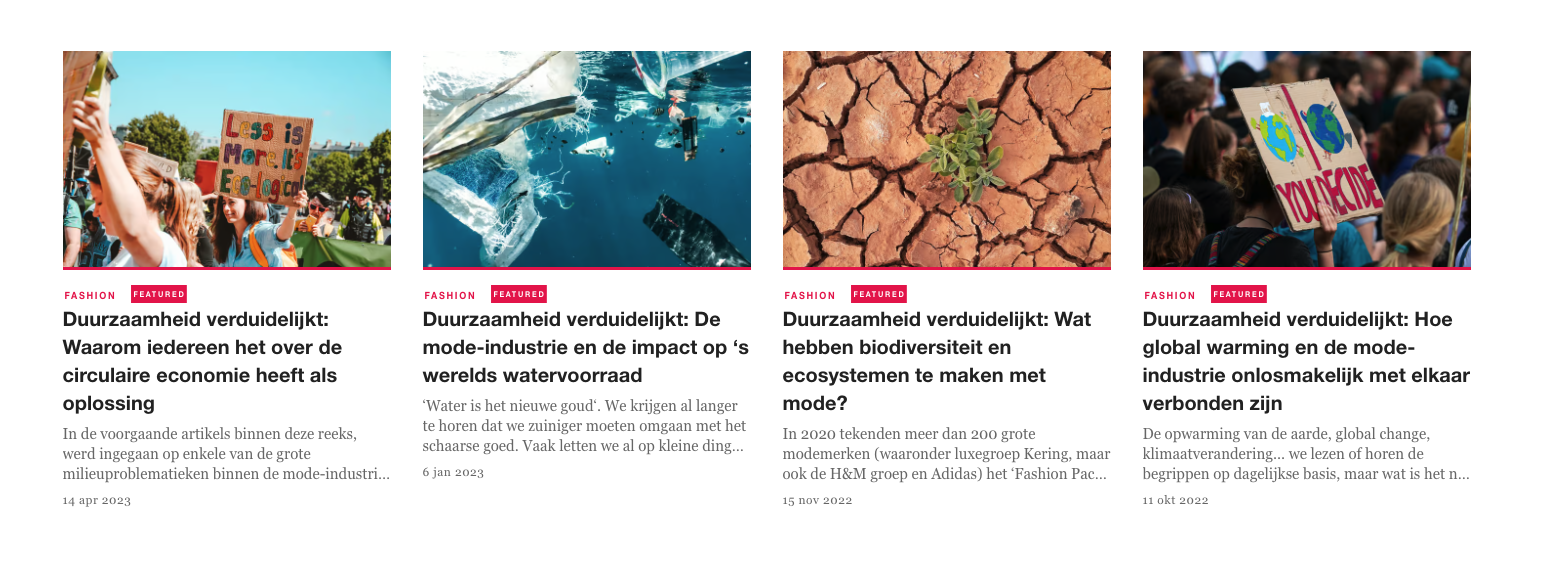

Article by Jasmien for Fashion United: How global warming and the fashion industry are inextricably linked
ON ‘Sustainability Clarified’ – a series of Jasmien Wynants for Fashion United.
In this series, we take you into the wonderful world of environmental science. Each article clarifies a key topic related to ‘sustainability’. We zoom out to the bigger picture and then look in more detail at how these complex concepts are linked to the fashion industry.
This time, we talk about… global warming.
October 11, 2022, Fashion United
Global warming, what is it?
It is important to distinguish between ‘global change’ and ‘climate change’. The latter is just one example of the many changes on our planet that we are aware of and falls in line with examples like ‘biodiversity loss’ and ‘nitrogen enrichment’.
Global change is nothing new. Consider the ‘continent drift’: the continents as we know them today did not exist in that form millions of years ago but stuck together. Those movements admittedly took millions of years to take place. Such changes had a lot of impact but were slow, whereas today’s climate change is happening much faster. Two major tipping points caused that acceleration, which is why we can now see the world changing before our eyes.
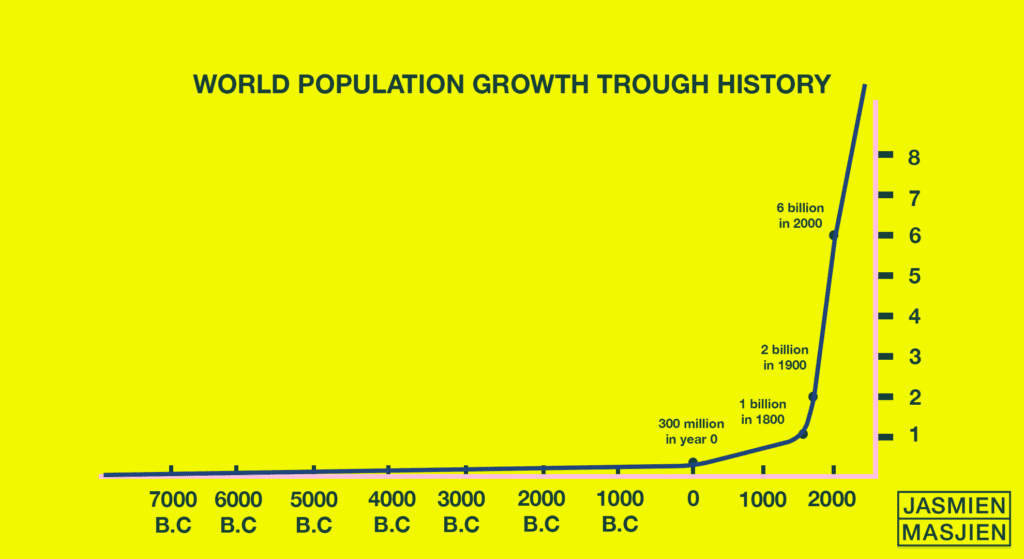
The first tipping point is found with the industrial revolution. In the eighteenth century, this made us much less dependent on human and animal power for heavy labour because machines could take over. In addition, the production of artificial fertilisers in the early twentieth century led to a huge increase in agricultural productivity.
Together with a general advance in medical science, these “revolutions” allowed us to feed more mouths, and live better and longer. Population growth exploded, and that had consequences… Because more people means more CO2.
Global warming, what is it?
Humans live. We move around, heat our homes, switch on the lights, and we use fossil fuels to do so (oil, gas, coal, lignite). The enormous increase in population and the use of more and more machines (industrial revolution) have caused us to burn more and more fossil fuels. And it is precisely these fuels that cause rising CO2 concentrations … which in turn lead to global warming. The food industry and the fact that we have started eating more and more meat over the past 100 years are also major contributors to greenhouse gas emissions. Cutting down forests to make way for (food for) livestock releases a lot of CO2. (Plants and trees extracted and stored CO2 from the atmosphere for tens of millions of years. We now burn that CO2 and it all returns to the atmosphere in a very short time).
The greenhouse effect: it’s not just CO2 that warms the earth
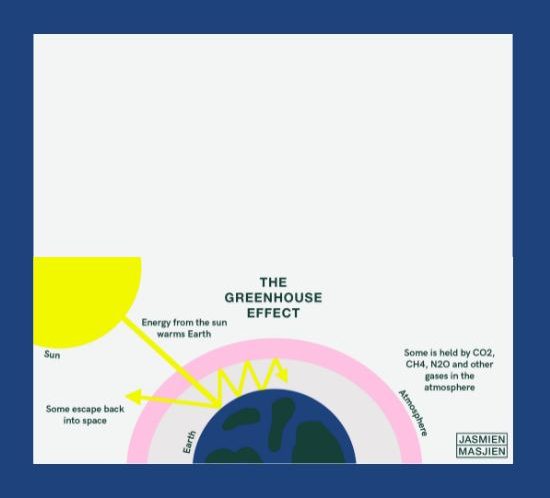
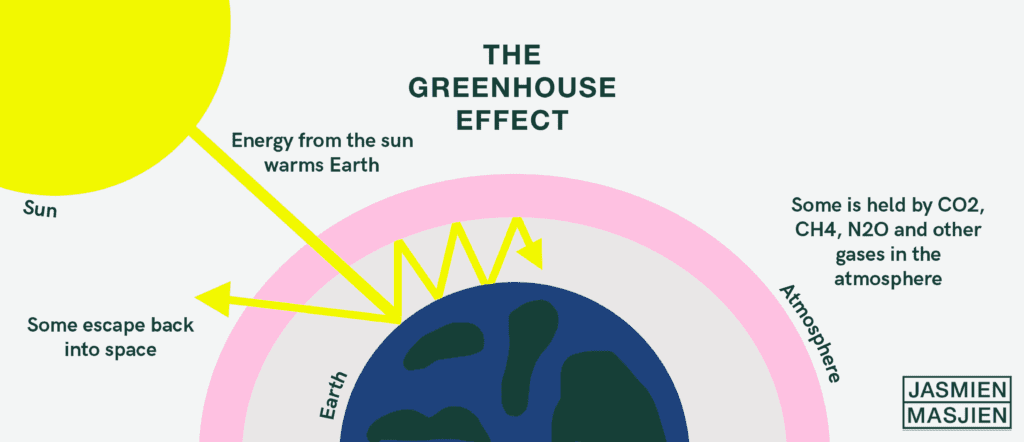
Just over half of global warming is caused by the increase in CO2 thanks to the famous ‘greenhouse effect’. Besides CO2, methane and nitrous oxide are also important greenhouse gases because they cause more warming per molecule. Methane comes mainly from agriculture (cattle are ruminants and emit methane in the digestion process, for instance). Nitrous oxide also occurs in agriculture but also in industry and traffic.
Greenhouse gases help the earth keep up with heat. And that is just as well. We know that without greenhouse gases, the Earth’s average temperature would be more than 30 degrees lower than now. And so our planet would be largely unlivable. But… the concentration of greenhouse gases has skyrocketed in recent years, trapping much more heat.
This ‘greenhouse effect’ has more consequences than just global warming. The expected increase in extreme weather (drought, heat waves, downpours,…) is just one of the consequences. Entire ecosystems are put under pressure by climate change, there are shifts in seasons, impacts on fresh water, a strain on agriculture, rising sea levels, melting glaciers, flood hazards for low-lying areas, increased mortality from extreme heat, economic consequences, dehydration, wars, climate refugees,…
And the biggest danger? That’s what climate scientists call the ‘snowball effects’. There are many possible ‘positive feedbacks’ that we don’t all know about yet, but which it is estimated that ‘once set in motion, they are still hard to stop’. Like a ball that pushes you down a small slope and into a deep valley. To get that ball back down the slope, you have to push much harder than to get it moving initially.
The danger of the global temperature rise exceeding 1.5-2 °C is there… and climate scientists fear that we will then end up in a ‘hothouse earth’ that will be difficult to get out of.
So that 1.5°C, what about it?
So in 2015, world leaders at the Paris Climate Agreement agreed that the warming of our planet should be limited to 2 degrees (and preferably 1.5 °C) compared to pre-industrial levels. The 1.5 limit is an important one because it is the point at which climate effects will thus become increasingly harmful to humans and the planet. And some of those effects are also irreversible.
Unfortunately, the likelihood of faster global warming is increasing all the time. The World Meteorological Organisation (WMO) announced in May 2022 that there is a 48% chance that we will be at that 1.5 degree warming even before 2027. (The years before, that probability was assumed to be rather small).
And can we talk about fashion now?
There is a strong call for industry, governments, consumers, all of us to make a maximum effort to combat global warming. So the fashion industry also has a role to play in this.
According to the Ellen McArthur Foundation (A New Textiles Economy: Redesigning Fashion’s future), total annual greenhouse gas emissions from textile production are more than those of all international flights and shipping combined (1.2 billion tonnes per year).
The fashion industry emits a lot of greenhouse gases during the production phase, but it is also an international industry that sends parcels and containers all over the world to get clothes from the producing countries (often in the Far East) to shops and customers. Not to mention the amount of packages we order and return every day while shopping online.
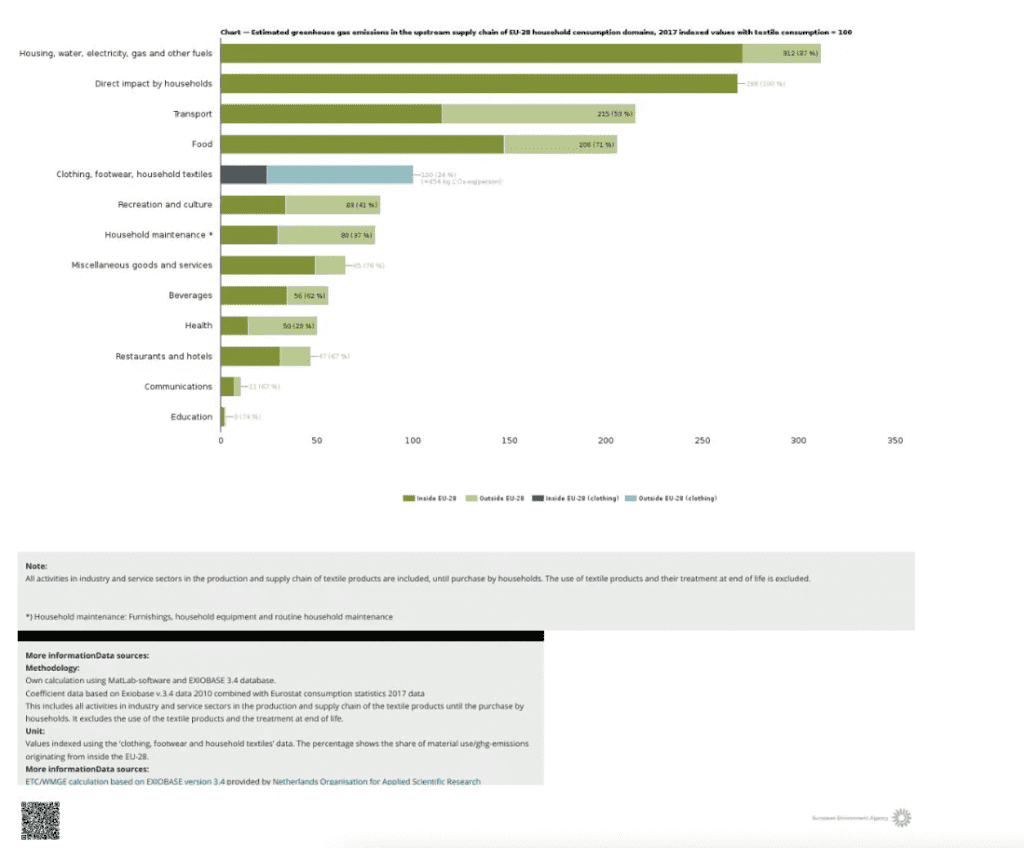
According to the European Environment Agency (EEA), textile production generates around 15-35 tonnes of CO2 equivalent per tonne of textile produced. Clothing, shoes and household textiles rank fifth in the EU in greenhouse gas emissions. This is more emissions than : recreation & culture, beverages, health, restaurants & hotels and communications, among others (Figure 3 from EEA below).
Not only does the use of fossil fuels in making and transporting our clothes lead to an increase in CO2, deforestation also contributes. Trees store carbon, but so when you burn them, that carbon is released back. When trees are cut down, the roots rot and the organic material is converted into CO2 and methane… which again leads to more greenhouse gas emissions. So every time we have to make space to grow livestock (both for food and leather) or establish cotton plantations, for example, this has an effect.
A lot of fashion companies are therefore now setting up ‘Science Based Targets’ (SBTs). This is part of an initiative by CDP, UN Global Compact, WRI and WWF whereby company targets are set to stay within the 2°C increase. Companies start by measuring their carbon footprint (Carbon Footprint) to get a better picture of where their major impacts are and how to reduce them. They then set concrete targets for their short-term and long-term emissions reduction strategy.
Finally, it is important to look not only at the industry but also at the fashion consumer. We then spontaneously think of how we can reduce our impact by washing, ironing or using the dryer less, washing at lower temperatures but also by cherishing our clothes for longer. After all, it is too bad to throw away a garment that required so many raw materials and fossil fuels after only a few uses?to the fashion consumer. We then spontaneously think of how we can reduce our impact by washing, ironing or tumble-drying less, washing at lower temperatures but also by cherishing our clothes for longer. Surely it is too bad to throw away a garment that has required so many raw materials and fossil fuels after only a few uses?
We asked the scientist… Hans De Boeck, Global Change Ecologist at the University of Antwerp
“Keeping climate warming within limits, below +2°C and if possible below +1.5°C, is very important because scientists from all kinds of fields estimate that the negative consequences for people and nature become very large above these limits. Every sector will have to make a solid effort, including the fashion industry. This is not only necessary, it is also useful in the longer term for the sector itself, e.g. because energy costs can be reduced.”
“There is work to be done. The clothing sector is very wasteful: hardly any discarded clothing is recycled (< 1 per cent), and unsold products are still too often simply destroyed by incineration. Moreover, we buy more and more clothes, in the US, for example, 3x more than in the 1960s. Fast fashion is a minor disaster for the environment. Although it does not sound very appealing, the best ‘climate measure’ is simple enough to buy less new clothes. Other options for greening: consciously look at the fabrics used, with animal products like wool and silk grosso modo having a higher climate impact than plant-based ones like flax, hemp and cotton. Further: recycle and reuse more. Finally: putting clothes in dryers or ironing less or not at all, as both are energy-consuming activities. Clear indications on clothing about the climate and/or environmental footprint may be useful to raise awareness, although care must be taken to avoid greenwashing (selling something as environmentally friendly when it is not) encouraging consumers to buy ‘more’ anyway.”